essays

reviews by the editorial staff
FOUNDER
Federico Bucci
DIRECTOR
Elisa Boeri
DEPUTY DIRECTOR
Elena Fioretto and Claudia Tinazzi
SCIENTIFIC COMMITTEE
Ángela García de Paredes, Jean-Philippe Garric, Ana Tostões, Elisa Valero Ramos, Bianca Gioia Marino, Andrea Sciascia, Filippo Lambertucci, Chris Whitehead
EDITORIAL BOARD
Samanta Bartocci, Luca Cardani, Luciana Macaluso, Lorenzo Mingardi, Beatrice Moretti, Elena Pozzi, Rosa Sessa
EDITORIAL STAFF
Alessandro Benetti, Alberto Bologna, Federica Causarano, Annalucia D’Erchia, Francesca Giudetti, Fabio Marino, Martina Meulli, Michela Pilotti, Sofia Celli, Giorgio Danesi, Roberta Folgiero, Lino Cabras
PHOTO BY
ARCò, Ibrahim Berisha, Alba Marcela Britez Cordoba, Heather Clydesdale, GRACE, Giuseppe Gradella, Armin Linke, Roland Halbe, Alexey Naroditsky, Roberto Saez, Luka Skansi, Uppsala Conflict Data Program UCDP, Guy Welborne
ARCHIVE
IUAV Archivio Progetti - Andrea Bruno Collection
ISSUE N.4
Heritage Cities and Conflicts December 2025
Edited by Sofia Celli (Politecnico di Milano), Elena Fioretto (Politecnico di Milano), Elena Pozzi (Ministero della Cultura)
ISSN
2974-8216
Periodicity
Biannual Magazine
Code of Ethics
The full version of the ADH Journal code of ethics is available at this link.
Editorial guidelines
The submission of abstracts and the entire paper submission process takes place via the ADH Journal platform. The editorial guidelines, provided during the paper submission, are also available at this link.
Referee
ADH Journal subjects published contributions to a double-blind peer review process. The journal employs suitable reviewers to assess contributions for publication based on their background and specific research. The journal\'s editors may decide not to submit the text for review by the referees because it does not meet the editorial line of the issue (not scientifically rigorous or not legally acceptable). The judgments of the referees are promptly sent to the authors of the selected contributions.
The list of reviewers of ADH Journal is available at this link.
Printed and Published by
Publi Paolini
Via R. Zandonai 9
46100, Mantova
Contacts
Politecnico di Milano, Polo Territoriale di Mantova
Piazza D’Arco 3, 46100 Mantova
Graphic layout
ParcoStudio - Milano

exhibition
historical references
italian architecture
politics
an exhibition curated by
Massimo Ferrari and Claudia Tinazzi
with Alba Marcela Britez Cordoba and Annalucia D’Erchia
working team
Arianna Huaman, Giulia Martinelli, Alexia Melzi
exhibition planned and promoted by
Politecnico di Milano – Mantova Campus
UNESCO Chair in Architectural Preservation and Planning in World Heritage Cities
for
Casa del Mantegna, Provincia di Mantova
models
Arianna Huaman, Giulia Martinelli, Alexia Melzi (Politecnico di Milano – Mantova Campus)
BRG studio
Undurraga Deves Arquitectos Ltda
photo credits
Felipe Diaz, Ronald Halbe, Sebastian Mallea, Cristobal Palma, Sergio Pirrone, Taller Pizarra, Roberto Saez, Pilar Undurraga, Gregorio Vasquez, Guy Wenborne
video
Alexis Moreno
exhibition set up
En’t Graphic, I falegnami, TB legno
thanks to
Estudio Undurraga Deves, Ana Deves, Federica Pugliese, Soledad Fernandez, Sebastian Mallea, Jua Jose Correa, Pablo Camus, Marcelo Morales, Fundacion Museo Violeta Parra, Maurizio Lionetti, Francesco Coroni, Mattia Ridolfi, Corrado Kay Hwa Severino, Mantova Campus Staff
ITALIAN CONNECTION
“We want to be a country and we are barely a landscape”, said the poet Nicanor Parra, emphasising the pre-eminence of landscape over everything. Space – the freedom of space – is perhaps one of the most abundant assets of this earth. All this makes my notion of space very different from yours (from the Italian one). The idea of space in this finis terrae always refers to the scale of the landscape. That is why my recent visit to Rome was – as always – such a unique experience.
BEFORE THE CITY. THE ORIGIN
The challenge we face as a society is to reconcile those aspects in which globalization has brought progress for humanity with the values inherent to the cultures that preceded us and that today fight to keep their identity alive.
SOCIAL AND POLITICAL CONFLICT
The history of a conflict
The rubble and debris from the Government Palace left a profound mark on our society. The wounds that were opened, the pain of the victims, and the mourning that followed keep the CONFLICT alive, more than 50 years later.
SOCIAL AND POLITICAL CONFLICT
City and politics. The conflict
The Civic District project in Santiago, initiated in 1980 and continued from 1995 to the present day, collects the rubble and shards that fell there during the dictatorship, creating a new urban landscape to celebrate the reconciliation of Chileans – a project that also reflects the intimate relationship between citizens and their public spaces, whose destinies are inexorably linked. The plazas and do not resolve our conflicts, but they offer spaces where we can come together.
URBAN CONFLICT
We must propose a strategy of cultivating the city. This entails responsible and sustainable development inspired by a collective ethic, one that rejects greed and short-term development strategies. It is in that practice where we will find the appropriate response for the urban future of the planet, and where we can stop the dangerous urban and social erosion, making our habitat a dignified and just place. The first problem is ethical… Only then can we think about the technical.
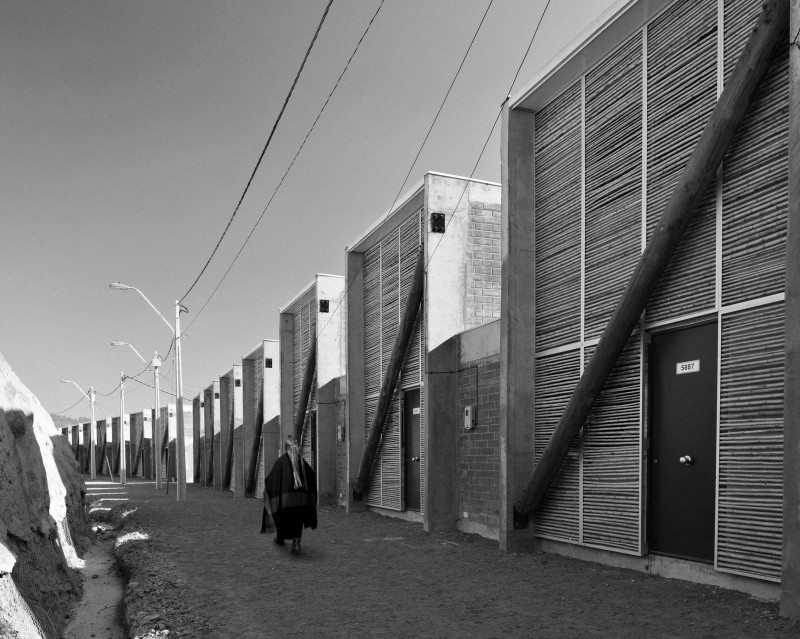
The exhibition reinterprets the work of Cristian Undurraga (Santiago de Chile, 1954) through the theme of conflict, which is so deeply rooted in Chile's DNA and complex history. Undurraga's work, generously supported by the Undurraga Devés Arquitectos studio founded in 1978 together with his wife Anna Deves, explores architecture as a complex system of themes that interact in a complementary way. These themes gradually evolve over time, alongside the cultural and technological progress of the world, to build hospitality as a permanent condition, deeply rooted and an integral part of the substance of architecture.
According to a threefold register and a multidisciplinary interpretation, the exhibition highlights selected projects from the Chilean studio's extensive portfolio that best embody the central role of contemporary architecture in various conflictual contexts, a role that stems from the certainty of the ethical value attributed to the work of architects in every era and in every latitude and longitude.
Identity in conflict, social and political conflict, and finally urban conflicts – like chapters in a singular narrative reflecting on the history of a finis terrae country – translate in this exhibition the many forms in which conflict manifests itself, binding populations, cities and architecture together.
As part of this narrative, made up of stages based on drawings, models, references and historical material, the work of the Undurraga Devés Arquitectos studio recognises, in its opening, the close link – both personal and, more generally, in terms of Chilean architecture – with our country, Italy, an important architectural and cultural reference point, especially in the country's rebirth after Pinochet's military dictatorship.
The exhibition, which has been hosted by Casa del Mantegna since 14 May 2025, has attempted to reach out to the various audiences who have visited the sequence of rooms that make up the house. Different possible routes have suggested different insights as well as different interpretations.
The exhibition interpreted the place that hosted it first and foremost in terms of the close connection between the spacious rooms that follow one another without interruption and the beautiful courtyard onto which these introverted spaces overlook.
The exhibition attempted to tell many stories: on the one hand, the architecture of a South American studio that decided to work – often silenciously – in the service of collective and social issues; on the other, the art of a South American woman, Violeta Parra, who fighting for social justice and the preservation of traditional identity in her country; and finally, the story of a country “where the earth ends”.
Ekaterina Golovatyuk
Giorgio Danesi Fabio Marino
Alessio Battistella
Luka Skansi