essays

reviews by the editorial staff
FOUNDER
Federico Bucci
DIRECTOR
Elisa Boeri
DEPUTY DIRECTOR
Elena Fioretto and Claudia Tinazzi
SCIENTIFIC COMMITTEE
Ángela García de Paredes, Jean-Philippe Garric, Ana Tostões, Elisa Valero Ramos, Bianca Gioia Marino, Andrea Sciascia, Filippo Lambertucci, Chris Whitehead
EDITORIAL BOARD
Samanta Bartocci, Luca Cardani, Luciana Macaluso, Lorenzo Mingardi, Beatrice Moretti, Elena Pozzi, Rosa Sessa
EDITORIAL STAFF
Alessandro Benetti, Alberto Bologna, Federica Causarano, Annalucia D’Erchia, Francesca Giudetti, Fabio Marino, Martina Meulli, Michela Pilotti, Sofia Celli, Giorgio Danesi, Roberta Folgiero, Lino Cabras
PHOTO BY
ARCò, Ibrahim Berisha, Alba Marcela Britez Cordoba, Heather Clydesdale, GRACE, Giuseppe Gradella, Armin Linke, Roland Halbe, Alexey Naroditsky, Roberto Saez, Luka Skansi, Uppsala Conflict Data Program UCDP, Guy Welborne
ARCHIVE
IUAV Archivio Progetti - Andrea Bruno Collection
ISSUE N.4
Heritage Cities and Conflicts December 2025
Edited by Sofia Celli (Politecnico di Milano), Elena Fioretto (Politecnico di Milano), Elena Pozzi (Ministero della Cultura)
ISSN
2974-8216
Periodicity
Biannual Magazine
Code of Ethics
The full version of the ADH Journal code of ethics is available at this link.
Editorial guidelines
The submission of abstracts and the entire paper submission process takes place via the ADH Journal platform. The editorial guidelines, provided during the paper submission, are also available at this link.
Referee
ADH Journal subjects published contributions to a double-blind peer review process. The journal employs suitable reviewers to assess contributions for publication based on their background and specific research. The journal\'s editors may decide not to submit the text for review by the referees because it does not meet the editorial line of the issue (not scientifically rigorous or not legally acceptable). The judgments of the referees are promptly sent to the authors of the selected contributions.
The list of reviewers of ADH Journal is available at this link.
Printed and Published by
Publi Paolini
Via R. Zandonai 9
46100, Mantova
Contacts
Politecnico di Milano, Polo Territoriale di Mantova
Piazza D’Arco 3, 46100 Mantova
Graphic layout
ParcoStudio - Milano
In post-conflict societies, architecture often plays a crucial role in shaping narratives of identity, legitimacy, and reconciliation. In the case of Kosovo, following the 1999 conflict and the dissolution of Yugoslavia, the Orthodox monasteries such as Deçan which has become more than religious and historical landmark, they are deeply contested symbols entangled in questions of sovereignty, cultural memory, and political power.
This research explores how these religious sites operate not merely as passive remnants of the past, but as active instruments within ongoing political negotiations between Kosovo and Serbia. Positioned at the intersection of cultural heritage, international diplomacy, and nation-building, these monasteries illuminate the complex ways in which sacred architecture is mobilized in efforts toward reconciliation, or conversely, in the entrenchment of division.
Using the Ahtisaari Plan (2007) as a legal and political backdrop, this study analyzes the strategies by which both state and non-state actors, such as the Serbian Orthodox Church, the Serbian and Kosovar governments, and international culture heritage institutions like UNESCO engaged with these monuments. Methodologically, the research draws from heritage theory and critical memory studies, interpreting heritage as an ongoing and politicized process of meaning-making rather than a neutral preservation of the past.
The findings reveal that religious heritage sites in Kosovo function as forms of soft power: they are mobilized to reinforce competing historical narratives, legitimize political claims, and influence peace-building efforts. This has broader implications for how international heritage regimes intended to preserve cultural monuments, can also become entangled in geopolitical agendas. The paper argues for a more critical and context-sensitive understanding of how architecture operates not only as a cultural asset but as a political instrument in unresolved conflicts.
On the westernmost part of Kosovo, on the edge of Lumbardhi river gorge, at the foot of Bjeshkët e Nemuna mountains, in the picturesque valley of Deçan1, stands the Monastery of Deçan2 (fig. 1). The monastery was built in the 14th century, its limestone walls and Byzantine frescoes have survived six centuries of Ottoman rule, two Balkan Wars, two World Wars, and finally the violent dissolution of Yugoslavia in 19993 (fig. 2). Yet perhaps no period during the history has made this monastery more contested than the years following the war of 1999 and the declaration of independence of Kosovo in 2008. The Monastery of Deçan is since 2004 enlisted a UNESCO World Heritage Site and from 2006 it is inscribed on the same list as World Heritage in Danger.
In the years that followed the Kosovo’s 1999 war, the orthodox monasteries have repeatedly become a focal point of contestation and political debate between Kosovo and Serbia, as well as among international institutions involved in the region. As Barrie argues about the sacred places, that even they are typically valued as peaceful settings for the cultivation of devotion, spiritual connection and personal improvement through the belief, the political and social role of these places is many times overlooked4. Religious meanings and concerns have had a prominent role in a wide variety of political conflicts in recent decades5.
Understanding the political dimension of Serbian Orthodox monasteries in Kosovo requires recognizing the historically intertwined relationship between the Serbian Orthodox Church and Serbian state power. The Church's institutional foundations in the thirteenth century under Sava Nemanjić established a pattern of close alignment with state authority and political objectives that has persisted across centuries6. This historical trajectory has led scholars to observe that the Serbian Orthodox Church functions simultaneously as a religious institution and as a vehicle for national political aims, with its structures often serving strategic state interests7.
This paper examines how the orthodox heritage in Kosovo have been instrumentalized as political tools to maintain influence in post-war Kosovo. Referring to that, it argues that the monasteries in Kosovo that are under administration of the Serbian Orthodox Church extends beyond its architectural and religious value.
This paper argues that Orthodox monasteries in post-conflict Kosovo function as instruments of "sacred sovereignty"—sites where competing claims of political legitimacy, historical memory, and territorial authority have materialized, contested, and negotiated through the language of cultural heritage. By analyzing an underexamined geopolitical context in heritage studies, Kosovo, and positioning it within broader theoretical debates on dissonant heritage in conflict zones, this research contributes to the international scholarship with its significance for understanding how cultural preservation mechanisms operate in contested places. The analysis argues that architectural heritage functions as an active agent in processes of violence, reconciliation, and identity formation. It reveals how international heritage frameworks, designed to protect cultural monuments, can become entangled in political debates, raising critical questions about their role in post-conflict societies.
The research takes as a case study the Monastery of Deçan, examined as a microhistory that reflects broader dynamics of the orthodox heritage in Kosovo, while acknowledging that each monastery possesses its own specificities. The paper addresses three interrelated dimensions of how they operate as instruments of sacred sovereignty: firstly, the legal protection framework established by the Ahtisaari Plan and Kosovo's constitution that grants the Serbian Orthodox Church authority over territory and development; second, the strategy of heritage diplomacy to block Kosovo's UNESCO membership bid; and lastly, the long property dispute over monastery lands that reveals how ecclesiastical property claims operate as territorial assertions constraining Kosovo's sovereign authority over spatial planning and economic development.
This study uses a variety of methods, combining document analysis, discourse analysis, and critical engagement with heritage theory.
The primary documents analyzed are legal and policy documents that include the Ahtisaari Plan (UN Security Council Document S/2007/168, 2007), Kosovo Constitution (2008, 2016), Kosovo's Law No. 03/L-039 on Special Protected Zones (2008) with particular attention to heritage protection provisions, the Constitutional Court decision (2016) regarding the Monastery of Deçan property rights, the UNESCO Nomination Dossier for Deçan Monastery (2002), and UNESCO World Heritage Committee monitoring reports and decisions (2004-2023). These documents were issued by different institutions, Kosovo government bodies, Serbian authorities, and UNESCO, providing multiple institutional perspectives on heritage protection and sovereignty. They were selected for their direct relevance to the institutionalization of heritage protection mechanisms and their legal effects on sovereignty and territorial authority.
Then the methodology delves to the use of media and discourse analysis: Media sources analyzed include Albanian-language sources from Kosovo (Koha Ditore, K2.0, Evropa e Lire), Serbian sources (Politika, KoSSev, Serbian Orthodox Church website), and international media coverage (The New York Times, Associated Press, Balkan Insight). Materials were collected on focusing on coverage of heritage disputes, political statements about monasteries in Kosovo, UNESCO membership debates, and property conflicts. The discourse analysis examines how different actors frame monasteries and heritage protection: as endangered sites requiring international protection (Serbian framing), as instruments of territorial claims limiting sovereignty (Kosovo Albanian framing), or as “neutral” cultural preservation (international institutional framing). Analysis focused on identifying rhetorical strategies, narrative patterns, and the political deployment of heritage language.
Sources were analyzed in Albanian, English, and Serbian. As an Albanian-speaking researcher from Kosovo, I bring insider knowledge of local contexts, while engaging critically with Serbian, Albanian, and international sources to provide balanced analysis of competing heritage claims.
Through the history, Kosovo’s cultural heritage was subject of temporal, geographical, physical and symbolical forces8. Due to its ethnically diverse population, central location, recent historical changes and varied cultural heritage, Kosovo is often characterized as a reduced scale model of the Balkans9. During the most recent war in 1999, cultural heritage became a battleground for the region’s deep-rooted fragmentations. As a result, the Kosovo conflict has condensed the notion of collective memory and common history. As Anthony D. Smith notes in a broader context, cultural heritage is often viewed as “a legacy belonging to the past of ‘the other’”, and in times of conflict, it becomes a target that adversaries seek to “damage or even deny”10.
Rather than understanding heritage as a fixed set of objects or sites passively inherited from the past, critical heritage studies conceptualize heritage as an active process of meaning-making that is embedded in power relations. The concept of “Authorized Heritage discourse” of Laurajane Smith argues how the dominant heritage narratives privilege certain communities connection to heritage and obscure political processes through which designations are made11. In this terms heritage simultaneously functions as a source of identity and belonging while also creating boundaries that exclude others. The process of attributing meaning to the past through heritage designation is never performed neutrally but always serves contemporary political, social and territorial objectives. In the case of Kosovo, orthodox monasteries, have been deliberately mobilized to negotiate political positions, create divisions and advance competing sovereignty claims.
Building on this understanding of heritage as contested terrain, the concept of dissonant heritage, developed by John Tunbridge and Gregory Ashworth, addresses the inherently conflicting nature of heritage that emerges when different actors attribute contested meanings and values to the same sites12. They distinguish between the past – what has occurred, history – selective descriptions of that past and heritage – a contemporary product shaped from history through selection and interpretation. This analytical distinction recognizes that dissonance is created each time something is designated as heritage, since the selection process privileges certain meanings while ignoring others. Southeast Europe exemplifies these dynamics with intensity. The region of Former Yugoslavia has experienced recent wars, ethnic conflicts, and territorial disputes that have made heritage dissonance highly visible13. Heritage, throughout these transformations, has been actively used to negotiate power, create divisions, and fuel antagonism among and within nation-states, Kosovo included. Especially, these discourse has been used in relation to religious heritage, where Orthodox churches have been associated with Serbian national identity and mosques with Albanian identity, turning sacred sites into symbols of ethno-national belonging and exclusion.
Taking into consideration these theoretical frameworks, this paper proposes "sacred sovereignty" as a conceptual framework for analyzing how religious heritage sites operate as instruments of political authority in contested post-conflict territories. Sacred sovereignty refers to the processes through which religious institutions, via their material presence in sacred architecture and their spiritual authority, exercise forms of territorial control and political power that operate alongside, overlap with, and contest state sovereignty.
Sacred sovereignty gets some defining characteristics distinguishing it from territorial sovereignty. First, it derives legitimacy from temporal depth and spiritual authority rather than from modern state formation, its claims are grounded in medieval religious history and sacred narratives. Second, sacred sovereignty operates through transnational religious networks that create authorities extending beyond state boundaries, enabling religious institutions to mobilize international support independently of state actors. Third, it is materially inscribed in architecture and landscape, with claims literally built into territory in ways that endure across political transitions and resist erasure.
In post-conflict Kosovo specifically, sacred sovereignty names the collection of legal mechanisms, spatial practices, symbolic performances, and international frameworks through which Serbian Orthodox monasteries function as nodes of Serbian authority despite Kosovo's independence. The Ahtisaari Plan's heritage protection provisions create legal foundations for this sacred sovereignty by granting the Serbian Orthodox Church power over land use, establishing protective zones that limit Kosovo's territorial control, and creating international oversight. These legal instruments transform religious sites from passive preservation objects into active institutional actors with legal standing and authority.
The Balkans have been shaped by a complex interweaving of cultures, languages, and faiths As Michael Galaty observes. It has been historically positioned at a major crossroads and frequently subject to overlapping territorial claims and it’s turbulent past continues to complicate the study and management of its landscapes and cultural heritage. Throughout history, including the present, state and imperial authorities have actively used heritage to challenge competing territorial narratives and assert control over space14.
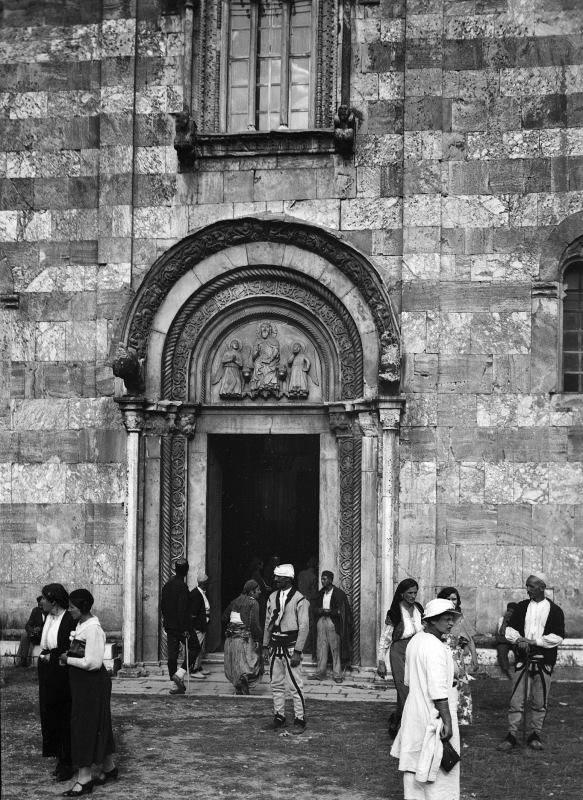
Kosovo’s cultural heritage reflects this layered and contested condition. Medieval Orthodox monasteries, alongside Islamic religious and civic structures, formed part of a shared cultural landscape that predates modern nation-states. However, in contemporary discourse these sites have been retrospectively framed through competing Albanian and Serbian narratives of historical continuity, ownership, and custodianship. The orthodox monasteries in Kosovo, commonly referred to as Serbian Orthodox Monasteries, are imbued with explicit ethnic and national significance and occupy a central place within Serbian historical and cultural narratives. And with the Monastery of Deçan, notions of belonging to the monastery have never been exclusive. Across historical periods, Albanians in the region expressed connection to Monastery of Deçan and regarded it as part of the shared cultural and religious landscape (fig. 3).
The Monastery of Deçan was constructed between 1327 and 1335; it stands as one of the largest and most architecturally significant complexes of the era in the region. The church, including the dome, is 32m high, and during the medieval period it was known as High Deçani. From the outside, the church's construction is a mixture of Romanesque and Gothic styles, while inside it is covered with traditional combined drawings of Eastern Orthodox and Byzantine styles. The main architect of the Monastery of Deçan was the master Fra Vito from Kotor, a Franciscan monk, who decorated the monastery with many elements that distinguish Romanesque15.
Medieval history plays a powerful role in modern heritage politics16. The Battle of Kosovo in 1389 became a foundational myth within Serbian collective memory, transforming Kosovo into a sacred national landscape through historiography, religious ritual, and epic poetry. The Serbian Orthodox Church, had a big role in managing the campaigns for the revival of the Kosovo Myth in the mid-1980s17. This mythology culminated in the 600th anniversary commemoration in 1989, when Milošević instrumentalized medieval symbolism to legitimize contemporary political claims, when Serbs gathered near the alleged battlefield on June 28th, carrying nationalist banners and paying tribute to fallen mediaeval heroes18. Remarkably, behind him on the podium was a row of Orthodox bishops19. This event marked a turning point in the rise of nationalist mobilization and the dissolution of Yugoslavia. It later shaped international debates on sovereignty, minority protection, and heritage rights.
During the Kosovo War the destruction of mosques, kullas the traditional dwelling of Albanians known also as “stone fortress”, çarshia the bazaar district that functions as the focal point of community social and economic life, and others were used as a strategy to erase material evidence of the Albanian community’s historical presence20 (fig. 4). The displacement of almost one million people during the war created also a disconnection of the communities with their built environment. Remarkably, not a single Serbian Orthodox church or monastery was damaged during the 1998-1999 conflict itself. As the clerk of the Monastery of Deçan recalled, during the summer when the peak of the fighting was going in the hills surrounding the monastery, the monks remained confined within the complex amid ongoing gunfire, there were no attempts to attack the monastery, nor was any damage inflicted on Serbian Orthodox churches in the area21.
However, post-war dynamics reversed. Following hostilities in June 1999, dozens of Serbian Orthodox churches were damaged in revenge attacks. The March 2004 riots, during which approximately thirty-five churches and monasteries were attacked over two days, fortunately not the medieval ones, further cemented heritage's position as contested political terrain and catalyzed international attention to protecting Serbian religious sites22 (fig. 5). It further cemented heritage’s position as contested political terrain.
The legal framework governing Serbian Orthodox heritage in Kosovo derives from multiple intersecting legal instruments operating at international, constitutional, and domestic levels. At the international level, four Serbian Orthodox monuments in Kosovo—Monastery of Deçan, Monastery of Graçanica, the Patriarchate of Peja, and the Church of the Virgin of Ljeviša—were inscribed on the UNESCO World Heritage List in 2004 (Deçan) and 2006 (the others as extensions) under the designation "Medieval Monuments in Kosovo," and simultaneously placed on the List of World Heritage in Danger23.
At the country level, the 2007 Ahtisaari Plan provided detailed provisions for heritage protection that were subsequently incorporated into Kosovo's Constitution (2008, amended 2016)24 and operationalized through domestic legislation including Law No. 03/L-039 on Special Protected Zones (2008)25. These interconnected legal instruments create a multi-layered architecture wherein international heritage obligations, status settlement commitments, constitutional guarantees, and domestic legislation converge to shape heritage governance in ways that generate ongoing tensions between heritage protection, minority rights, and sovereignty.
The Ahtisaari plan placed a record amount of emphasis on preserving Serbian religious and cultural heritage while aiming for "supervised independence." The creation of Special Protective Zones around about forty Serbian Orthodox sites and limitations on land use and development nearby were among the main clauses. Among the plan's most significant provisions were the establishment of Special Protective Zones around approximately 45 Serbian Orthodox religious and cultural sites, restrictions on construction and commercial activities within these zones, specific institutional mechanisms granting the Serbian Orthodox Church consultative and decision-making authority over activities affecting protected sites, recognition of Church property rights with dispute resolution mechanisms, and provisions for international monitoring and NATO security presence at selected locations26.
The placement of Medieval Monuments on the World Heritage in Danger List by UNESCO, represented essential safeguard responding to the threats against Serbian Orthodox heritage, IN the perspective of Serbia27. Serbian officials and the Serbian Orthodox Church argued that robust international guarantees were necessary prerequisites for any status settlement, the violence against Serbian religious sites and the symbolic significance of these monuments to Serbian national identity. The protective zones and institutional authorities were framed as minimal necessary protections to ensure minority religious communities could maintain their cultural and spiritual practices in conditions of safety and dignity.
From the Kosovo perspective, however, these provisions represented privilege protections for Serbian Orthodox heritage while providing less favorable frameworks for addressing the systematic destruction of Albanian cultural heritage during the 1998-1999 conflict. The special status given to the Serbian Orthodox Church, is viewed by many in Kosovo as embedding forms of Serbian institutional authority within Kosovo territory that complicate the exercise of sovereign governance. Critics note that while approximately 500 mosques and Albanian cultural sites were destroyed during the war, the international legal framework focuses disproportionately on protecting Serbian sites, creating perceived inequities in post-conflict heritage politics.
The Ahtisaari framework thus established the legal foundations for what this paper analyzes as sacred sovereignty: a configuration wherein religious heritage sites, protected through international legal commitments incorporated into domestic law, become nodes where competing claims to territorial authority, institutional legitimacy, and sovereign control are continuously enacted and contested. Rather than resolving tensions between heritage protection and sovereignty, the legal framework institutionalized these tensions, creating mechanisms through which unresolved political conflicts over Kosovo's status are perpetuated through ostensibly technical heritage governance arrangements.
Serbian Orthodox monasteries in Kosovo and their specific heritage status operates through interconnected dimensions of political engagement: diplomatic interactions within UNESCO frameworks and property disputes involving territorial authority. These dimensions were analyzed to reveal how heritage protection functions parallelly as cultural preservation and as a contested political arena where questions of sovereignty, territorial control, and national identity are negotiated between Kosovo, Serbia and international actors. While this analysis focuses primarily on the Monastery of Deçan, the patterns identified reflect broader strategies deployed by Serbian Orthodox Church.
The strategic deployment of cultural heritage in diplomatic contexts corresponds to what scholars describe as heritage diplomacy—the use of heritage sites, narratives, and protection mechanisms to advance political objectives within international arenas. Applying a heritage diplomacy framework helps to recast these dynamics within the political culture of international relations, while also acknowledging that contestation and cooperation are often intertwined rather than mutually exclusive. This approach therefore allows for a more analytically balanced understanding of heritage as both a site of conflict and a medium of negotiation28.
According to the Kosovo perspective, Serbia has deployed the international heritage framework, particularly UNESCO, in ways that serve both cultural preservation and political objectives. The action of Serbia to nominate the Monastery of Deçan as a Cultural monument in the UNESCO List immediately after the war in 2002 and afterwards place it in World Heritage in Danger in 2006, and mentioning the country as just Serbia, creates debates on heritage protection and sovereignty questions. This international heritage diplomacy achieved its most visible outcome in 2015, when Serbia, together with the Serbian Orthodox Church, influenced Kosovo’s bid for UNESCO membership. Despite Kosovo's application receiving broad support from member states, it fell short by merely two votes of the required two-thirds majority needed for admission29.
Serbia's campaign centered on claims that Kosovo could not be trusted to protect Serbian cultural heritage and ongoing security concerns as evidence of institutional incapacity. The Serbian Orthodox Church issued formal letters to UNESCO Director-General Irina Bokova emphasizing threats to medieval monasteries and arguing that UNESCO membership would legitimize what Serbia views as illegal secession from Serbian territory30. Serbian officials maintained that granting UNESCO membership to Kosovo while heritage sites remained endangered would contradict UNESCO's fundamental mission of cultural preservation. This framing allowed Serbia to position itself as the responsible protector of universal cultural heritage against an unstable entity unable to fulfill international preservation standards31.
Beyond the immediate question of UNESCO membership, this campaign reflected broader tensions in post-conflict heritage politics. From one perspective, it reinforced questions about Kosovo's institutional capacity and international standing. From another perspective, it demonstrated how heritage protection discourse can become entangled with sovereignty disputes.
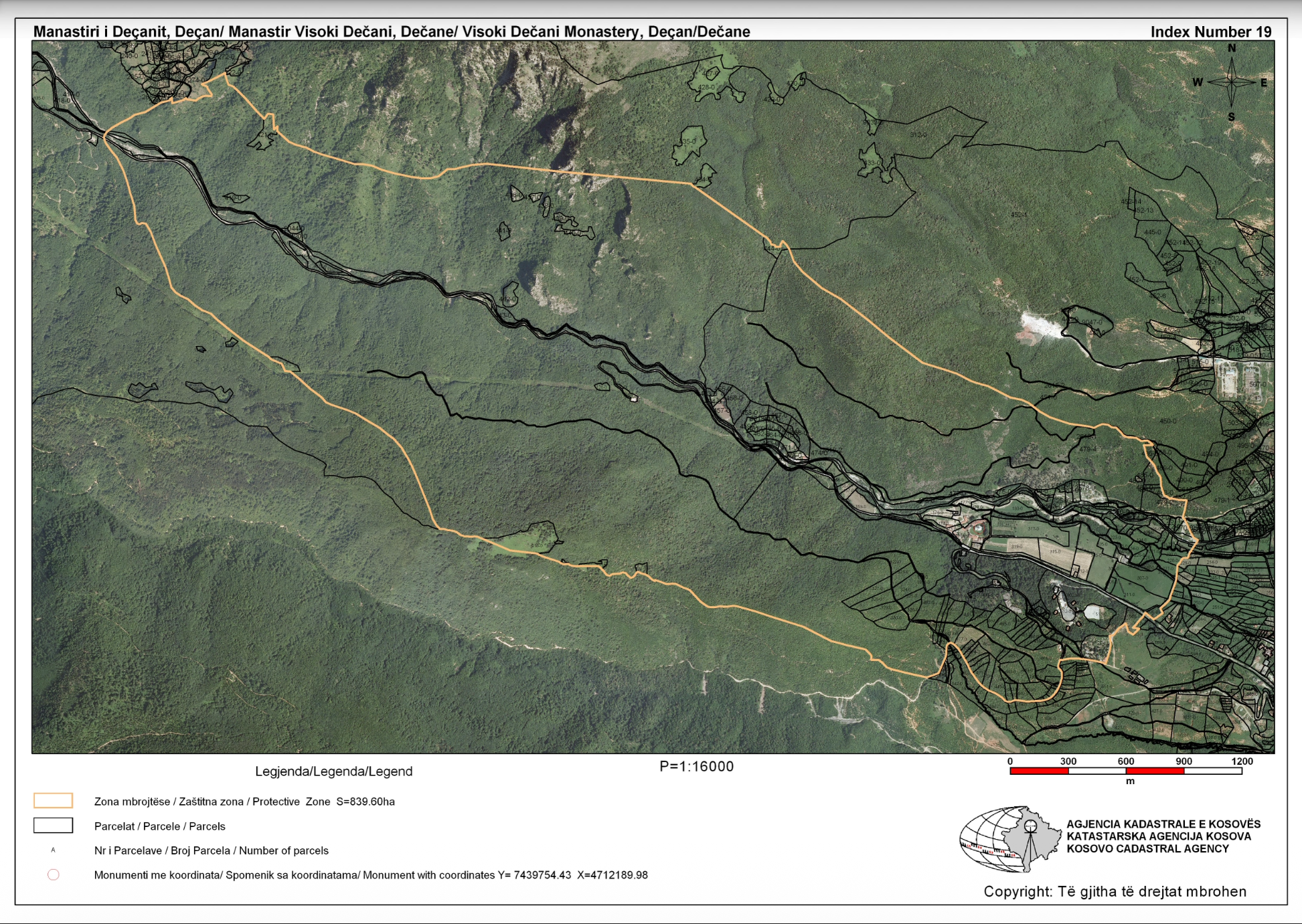
The heritage protection framework operates through multiple mechanisms that create tensions between different conceptions of authority. The special protective zones established around Serbian Orthodox sites create spatial arrangements where international oversight, Serbian Orthodox Church authority, and Kosovo governmental jurisdiction intersect in complex ways. When development activities require Church consultation or approval, questions arise about how different forms of authority—state, ecclesiastical, international—interact and sometimes conflict within post-conflict territorial arrangements. This dynamic is exemplified by multiple infrastructure conflicts, including the Deçan-Plav road project connecting Kosovo and Montenegro, which was halted when construction within the monastery's protective zone was prohibited following Serbian Orthodox Church objections, demonstrating how heritage protection mechanisms can constrain infrastructure development deemed important for Kosovo's economic integration32 (fig. 6).
In the case of the Monastery of Deçan, the manifestation of heritage as a territorial instrument is related to property rights disputes. According to the Monastery, approximately 24 hectares belong to the property given in 1997 during Milošević's regime. On the other hand, it is contested by Albanians who maintain that this land was forcibly appropriated under Milošević's regime, a period when systematic discrimination against Kosovo Albanians was institutionalized through state mechanisms33. According to the Serbian narrative, the monastery's historical property rights were illegally confiscated during the communist period, and restoration of these rights represents legitimate restitution rather than territorial expansion34.
As a result of international concerns about safeguarding the religious heritage of minorities in the aftermath of conflict, the Ahtisaari Plan mandated that Kosovo set up dispute resolution procedures with clauses that strongly favored the return of property to the Serbian Orthodox Church. The Supreme Court Special Chamber decided in favor of the monastery's ownership claims in 2012. However, the government refused to implement it immediately due to strong public pressure and worries that this would set a precedent for many other property disputes in Kosovo.
In May 2016, the Constitutional Court of Kosovo ordered the full implementation of the monastery's property rights and ruled that the government's obstruction was unconstitutional35. However, to this day, local authorities in the Municipality of Deçan have not fully implemented the Constitutional Court decision, citing the justification that the land was taken by force during the Milošević era and that recognizing the monastery's claim would validate historical injustices committed against the Albanian population. However, the Prime Minister of Kosovo, Albin Kurti, requested that the Kosovo Cadastral Agency transfer the lands to the Monastery of Deçan, as per the court decision36.
The land dispute of the Monastery of Deçan sheds light on sacred sovereignty as a political phenomenon from several angles. Firstly, it illustrates how areas of effective non-Kosovo authority are established within Kosovo's borders, thanks to property rights and upheld by the country's constitutional framework. Despite strong public opposition, the monastery, supported by the Serbian Orthodox Church and Serbian government, can make legal claims that the democratically elected government of Kosovo cannot override. Secondly, it illustrates how the concrete political realities of post-conflict societies, characterized by intense animosity, conflicting historical narratives, and unanswered questions about who has legitimate authority over territory, collide with the abstract legal principles valued in international discourse, including the rule of law, property rights, and international commitments. Thirdly, it demonstrates how monasteries operate as active material and legal actors with institutional standing, property rights, and the ability to make claims that directly challenge and limit the authority of the Kosovo state, rather than just serving as passive symbols.
Together, these dimensions—international heritage diplomacy through UNESCO and territorial assertions via property disputes demonstrate how heritage protection operates as a comprehensive political strategy. Heritage protection thus functions not as neutral technical preservation but as a contested political arena where unresolved sovereignty disputes continue to be negotiated through the ostensibly apolitical language of cultural preservation and international heritage frameworks. Both sides deploy heritage discourse strategically: Serbia to maintain influence and constrain what it views as illegitimate independence; Kosovo to demonstrate state capacity and challenge what it perceives as externally imposed limitations on territorial authority.
The concept of "sacred sovereignty" highlights how religious authority, historical memory, and territorial politics become mutually constitutive in contexts of contested statehood. In Kosovo's monasteries, multiple overlapping authorities—state, ecclesiastical, international—exercise competing powers over the same territory, creating hybrid sovereignty arrangements characteristic of unresolved post-conflict situations. These sites exemplify dissonant heritage at its most politically charged: the same monuments evoke radically different meanings, memories, and claims to legitimacy depending on one's position within the conflict. As Tunbridge and Ashworth theorized, such dissonance is not aberrant but intrinsic to heritage itself—yet in Kosovo, this inherent contestation is amplified by unresolved sovereignty, transforming cultural sites into active instruments of political struggle rather than neutral objects of preservation.
The international heritage framework in Kosovo, particularly UNESCO's involvement and the Ahtisaari Plan's protections, was designed to facilitate peace-building by ensuring the protection of Serbian cultural heritage in independent Kosovo. However, implementation has often reinforced division rather than enabling reconciliation. Protective zones inscribe ethnic boundaries into the landscape while generating resentment among Kosovo Albanians who perceive sovereign authority as constrained, even as Serbian communities view these protections as minimal safeguards for endangered heritage in a hostile environment.
This reveals fundamental tensions in heritage-based approaches to peace-building in contested territories. When heritage sites are deeply embedded in nationalist narratives, function as territorial claims, and require international oversight limiting state sovereignty, heritage mechanisms risk perpetuating conflict dynamics rather than resolving them. More critical heritage practice in post-conflict contexts would require explicit acknowledgment that heritage discourse is inherently political and that preservation decisions reflect power relations rather than neutral technical choices.
The monasteries of Kosovo will remain contested as long as broader sovereignty disputes remain unresolved. Their protection is important—they represent remarkable medieval achievements deserving preservation. This case has implications beyond Kosovo: wherever heritage sites become entangled in territorial disputes, similar dynamics of sacred sovereignty, heritage diplomacy, and politicization of protection regimes emerge, requiring critical engagement with how architecture operates as a political instrument in unresolved conflicts.
notes
The names of the river and mountains are given in the Albanian language. The translation for Bjeshkët e Nemuna mountains would be the Accursed Mountains in English. In Kosovo, all places, including Kosovo itself, have Albanian and Serbian names. In this text, I adopt the Albanian place-name forms, reflecting my first language and cultural context. Where appropriate, the Serbian equivalents are indicated for reference.
In the Serbian language, it is known as Manastir Visoki Dečani.
For the last war in Kosovo during 1998-1999, not a single Serb Orthodox church or monastery in Kosovo was damaged or destroyed by Albanians during the war. For more information, see Riedlmayer, András. 2014. “Introduction.” In Destruction of Islamic Heritage in the Kosovo War, 1998-1999, by Sabri Bajgora, edited by Robert Elsie and Petrit Selimi, 15-19. Pristina: Interfaith Kosovo, Ministry of Foreign Affairs of the Republic of Kosovo.
Barrie, Thomas. 2012. “Sacred Space and the Mediating Roles of Architecture.” European Review 20, no. 1: 79–94. https://doi.org/10.1017/S1062798711000330.
Stump, Roger W. 2005. “Religion and the Geographies of War”. In The Geography of War and Peace: From Death Camps to Diplomats, edited by Colin Flint, 149-173. New York: Oxford University Press USA.
Bajraktari, Jusuf. et al. 1996. “Kosova Issue”. In The Role of the Serbian Orthodox Church in Anti-Albanian Policies in Kosova. Prishtina: Academician Mark Krasniqi.
Ramet, Sabrina P., and Vjeran Pavlakovic. 2005. Serbia Since 1989. Politics and Society under Milosevic and After. Seattle: University of Washington Press.
Morel, Anne‑Françoise. 2013. “Identity and Conflict: Cultural Heritage, Reconstruction and National Identity in Kosovo.” Architecture_MPS 3, no. 1. https://doi.org/10.14324/111.444.amps.2013v3i1.001.
UNESCO. 2004. Cultural Heritage in South‑East Europe: Kosovo. Paris: UNESCO.
Smith, Anthony D. 1991. National Identity. New York: Penguin Books.
Smith, Laurajane. 2006. Uses of Heritage. London: Routledge, 11-43.
Tunbridge, J. E., and G. J. Ashworth. 1995. Dissonant Heritage: the management of the past as a resource in conflict. Chichester: John Wiley.
Kisić, Višnja. 2016. Governing Heritage Dissonance Promises and Realities of Selected Cultural Policies. Belgrade: Vizartis.
Galaty, Michael L. 2020. “Blood of Our Ancestors: Cultural Heritage Management in the Balkans.” In Springer eBooks, 109–24. https://doi.org/10.1007/978-1-4419-7305-4_4.
Kosovo Council for the Cultural Heritage official website, https://kktk.rksgov.net/CulturalHeritage/Details/31.
Ruggles, Fairchild. 2011. The Stratigraphy of Forgetting: The Great Mosque of Cordoba and Its Contested Legacy. Springer.
Šuica, Marck. 2010.“The Image of the Battle of Kosovo (1389) Today: a Historic Event, a Moral Pattern,or the Tool of Political Manipulation.” In The Uses of the Middle Ages in Modern European, edited by Robert John Weston Evans and Guy P. Marchal, 152-174. London: Palgrave Macmillan.
Whitaker, Raymond. 1999. “Liberation of Kosovo:Priests desert the national cause.” Independent, June 28. https://www.independent.co.uk/news/liberation-of-kosovo-priests-desert-the-nationalist-cause-1103001.html.
Riedlmayer, András. 2014. Op. cit., 15-19.
Perlez, jane. 1998. “Serbian Priest in Ancient Monastery Is a Thorn in Milosevic's Side.” The New York Times, October 12. https://www.nytimes.com/1998/10/12/world/serbian-priest-in-ancient-monastery-is-a-thorn-in-milosevic-s-side.html?searchResultPosition=12.
International Crisis Group. 2004. Collapse in Kosovo. Europe Report No. 155, 22 Apr. https://www.crisisgroup.org/europe-central-asia/kosovo/155-collapse-kosovo.
UNESCO World Heritage Centre, "Medieval Monuments in Kosovo," inscribed 2004 (Deçani) and 2006 (extension), https://whc.unesco.org/en/list/724. The sites were inscribed under emergency procedures and simultaneously placed on the List of World Heritage in Danger.
Republic of Kosovo, Constitution of the Republic of Kosovo, adopted April 9, 2008, entered into force June 15, 2008, Articles 8, 59.
Republic of Kosovo. Law no. 03/L-039 Për zonat e veçanta të mbrojtura. Gazeta Zyrtare e Republikës së Kosovës, No. 28 (04 June 2008). https://gzk.rks-gov.net/ActDocumentDetail.aspx?ActID=2529.
United Nations Security Council, "Report of the Special Envoy of the Secretary-General on Kosovo's Future Status," S/2007/168, March 26, 2007, https://www.securitycouncilreport.org/atf/cf/%7B65BFCF9B-6D27-4E9C-8CD3-CF6E4FF96FF9%7D/Kosovo%20S2007%20168.pdf.
UNESCO World Heritage Committee. (2006). Decision 30 COM 8B.54: Inscription of the Medieval Monuments in Kosovo (Serbia) on the List of World Heritage in Danger. UNESCO World Heritage Centre.
Winter, Tim. 2015. “Heritage Diplomacy.” International Journal of Heritage Studies 21 (10): 997–1015. doi:10.1080/13527258.2015.1041412.
Adamson, Thomas. 2015. "UNESCO rejects membership for Kosovo in victory for Serbia." The Associated Press, November 9.https://eu.goerie.com/story/news/nation-world/2015/11/09/unesco-rejects-membership-for-kosovo/25012242007/.
Holy Synod of Bishops of the Serbian Orthodox Church. 2015. Letter to Mrs. Irina Bokova, Director-General of UNESCO. https://eparhija-prizren.com/en/statements/holy-synod-bishops-serbian-orthodox-church-letter-director-general-unesco-ms-bokova-regar/.
“Serbia is no longer losing battles for its national interests”, Government of Serbia website, November 9, 2015.
The Deçan-Plav road project began in 2014 as an initiative of Kosovo's Ministry of Infrastructure connecting Kosovo with Montenegro through the Deçan valley. Construction issues with monastery protective zones emerged in 2018, leaving the project incomplete. Similar conflicts have affected infrastructure projects near other protected sites. According to Kosovo officials, the project was not intended to widen the existing road but merely to asphalt it.
Hysenaj, Shkelqim & Berisha, Ibrahim. 2022. "Çfarë ka në 24 hektarët përreth Manastirit të Deçanit?" Radio Evropa e Lirë, October 17, 2022.
Politika. 2024. "How Visoki Dečani Lost Their Land”. https://www.politika.rs/sr/clanak/604126/kako-su-visoki-decani-ostali-bez-zemlje.
Constitutional Court Judgment KI132/15 on the Request of Manastiri i Deçanit for Assessment of Constitutionality of Two Decisions of 12 June 2015. Gazeta Zyrtare e Republikës së Kosovës, 26 May 2016, https://gzk.rks-gov.net/ActDetail.aspx?ActID=12499.
“Kosovo Government: Lands to be transferred to Deçan Monastery”. 2024. Deutsche Welle.
Santiago Araque
Luka Skansi
Heather Clydesdale
Giorgio Danesi Fabio Marino