essays

reviews by the editorial staff
FOUNDER
Federico Bucci
DIRECTOR
Elisa Boeri
DEPUTY DIRECTOR
Elena Fioretto and Claudia Tinazzi
SCIENTIFIC COMMITTEE
Ángela García de Paredes, Jean-Philippe Garric, Ana Tostões, Elisa Valero Ramos, Bianca Gioia Marino, Andrea Sciascia, Filippo Lambertucci, Chris Whitehead
EDITORIAL BOARD
Samanta Bartocci, Luca Cardani, Luciana Macaluso, Lorenzo Mingardi, Beatrice Moretti, Elena Pozzi, Rosa Sessa
EDITORIAL STAFF
Alessandro Benetti, Alberto Bologna, Federica Causarano, Annalucia D’Erchia, Francesca Giudetti, Fabio Marino, Martina Meulli, Michela Pilotti, Sofia Celli, Giorgio Danesi, Roberta Folgiero, Lino Cabras
PHOTO BY
ARCò, Ibrahim Berisha, Alba Marcela Britez Cordoba, Heather Clydesdale, GRACE, Giuseppe Gradella, Armin Linke, Roland Halbe, Alexey Naroditsky, Roberto Saez, Luka Skansi, Uppsala Conflict Data Program UCDP, Guy Welborne
ARCHIVE
IUAV Archivio Progetti - Andrea Bruno Collection
ISSUE N.4
Heritage Cities and Conflicts December 2025
Edited by Sofia Celli (Politecnico di Milano), Elena Fioretto (Politecnico di Milano), Elena Pozzi (Ministero della Cultura)
ISSN
2974-8216
Periodicity
Biannual Magazine
Code of Ethics
The full version of the ADH Journal code of ethics is available at this link.
Editorial guidelines
The submission of abstracts and the entire paper submission process takes place via the ADH Journal platform. The editorial guidelines, provided during the paper submission, are also available at this link.
Referee
ADH Journal subjects published contributions to a double-blind peer review process. The journal employs suitable reviewers to assess contributions for publication based on their background and specific research. The journal\'s editors may decide not to submit the text for review by the referees because it does not meet the editorial line of the issue (not scientifically rigorous or not legally acceptable). The judgments of the referees are promptly sent to the authors of the selected contributions.
The list of reviewers of ADH Journal is available at this link.
Printed and Published by
Publi Paolini
Via R. Zandonai 9
46100, Mantova
Contacts
Politecnico di Milano, Polo Territoriale di Mantova
Piazza D’Arco 3, 46100 Mantova
Graphic layout
ParcoStudio - Milano
Some cities become faded on maps but solid in frames.
In Palestine, where walls rise and streets vanish, cinema becomes a quiet act of preservation, drawing invisible geographies, retracing erased architecture, and resisting the forgetting of place. Even the name 'Palestine' is burdened by a long history of attempted erasure, spoken less in official registers than in stories, memories, and films that refuse to forget.
This essay explores the defiant clarity of cinematic urbanism as a spatial response to conflict and colonial fracture. In cities where architecture is continually dismantled or denied, films such as Chronicle of a Disappearance (Elia Suleiman), Salt of This Sea (Annemarie Jacir), 5 Broken Cameras (Emad Burnat and Guy Davidi), and so many others construct palimpsests of space and memory. In their sequences, ruins are not endings; they are beginnings: visual traces reassembled through rhythm, cut, and gaze.
Here, the screen becomes a surrogate ground, a fragile but enduring terrain where the memory of place survives through displacement. Beneath each cinematic layer lies a negotiation between conflicting histories, postcolonial wounds, and the artist’s own interior unrest, a condition where architecture becomes less about building and more about holding onto the possibility of return.
As Jacques Derrida reminds us, the archive is never neutral; it shelters presence while inscribing absence. Palestinian cinema becomes such a counter-archive: one that resists disappearance not through reconstruction, but through trace, sequence, and affect.
In the spirit of Edward Said’s contrapuntal vision, where exile gives rise to overlapping temporalities and spatial imaginaries, these films inhabit dissonance; they do not seek to restore the city but to reimagine it in fragments, in shadows, in rhythms of remembrance. What emerges is not a traditional palimpsest of historical layers, but a contrapuntal palimpsest—a cinematic space where multiple narratives, memories, and absences coexist in tension. The visible and the erased, the remembered and the forbidden, the city as it was and as it is dreamt—these elements remain suspended, discordant, and alive.
Guided by Lefebvre’s spatial theory, Kracauer’s cinematic memory, and Bruno’s emotional cartographies, this contribution frames cinema not only as witness but also as architect: a medium of resistance, a vessel of memory, and a poetic structure in a landscape of uncertainty.
In Palestine, where reconstruction is often forbidden, and even the name must be defended, narration endures. And through that narration, the city is not only remembered but also rebuilt in vision.
When the physical construction of a city is systematically dismantled, denied, or overwritten by colonial geometry, architecture shifts from a material practice to a function of memory. The central thesis of this essay explores the defiant clarity of cinematic urbanism as a spatial response to conflict and colonial fracture. In the context of Palestine, where systemic land appropriation and mass expulsion date back to the late 19th century and culminated in the Nakba of 19481, the built environment is only defined by vulnerability2, as there is no permanence. This perpetual state of precarity creates a profound paradox: cities and villages3 become faded on official registers4, which are a conceived space, while they remain absolutely solid in the frames of cinema, representing a lived space.
This crisis of material space necessitates a Lived Space intervention, which can be a Cinematic intervention. Since architecture is continually dismantled or denied, the screen emerges as a crucial medium for architectural preservation and sometimes resistance. It functions as a surrogate ground where memory, political dissonance, and affective attachment coalesce, resisting the forgetting of place. The deliberate political function of Palestinian film is to serve as a counter-archive. While Jacques Derrida observed that the traditional archive shelters presence while simultaneously inscribing absence, the physical and legal archives governing Palestinian land are often inherently colonial, documenting and legitimizing erasure. Therefore, the cinematic archive must be deliberately non-neutral; its purpose is not only preservation for posterity but also an active, political refusal of the terms of colonial fracture. It resists disappearance not through material reconstruction, but through visual trace and profound affect.
Films, in this case, are always constructing palimpsests of space and memory. By studying them closely, one can see that ruins and visual traces get reassembled through rhythm, cut, and gaze. These traces do not seek to restore the city to a singular, harmonious past, but rather to reimagine it in fragments and in shadows. Guided by Edward Said’s contrapuntal vision5, the analysis defines the contrapuntal palimpsest as the resulting cinematic space. This is an architectural imaginary where multiple, conflicting narratives, the built and the erased city, the remembered street and the forbidden border, coexist in productive tension6, allowing for a nuanced reading of cinematic spaces in which colonial wounds and the artist’s interior unrest are mapped onto the urban environment. Cinema becomes a witness and also an architect: a medium of resistance and a poetic structure in a landscape of uncertainty, informed by Henri Lefebvre’s spatial theory7, Siegfried Kracauer’s cinematic memory8, and Giuliana Bruno’s emotional cartographies9.
Edward Said’s concept of the contrapuntal originates in the musical term ‘counterpoint,’ allowing for simultaneous, interwoven melodic lines10. Applied to spatial and political studies, one can find it beneficial for understanding the Palestinian experience of exile and statelessness. Displacement creates a double-vision, where the critic or artist sees the present ‘here and now’ simultaneously with ‘what has been left behind.’ The cinematic frame, acting as a site for this double perspective, allows discordant spatial realities, such as an Israeli-built settlement existing alongside the memory and lands of a destroyed or dispossessed Palestinian village; for instance, the expansion of the settlement Modi’in Illit onto the agricultural land of Bil’in documented in 5 Broken Cameras, the third cinematic layer of the analysis to play out without seeking immediate resolution. This conceptual tension is also powerfully illustrated in the second cinematic layer addressed later in the article, Salt of This Sea, when the protagonist, Soraya, visits her ancestral Jaffa home, which is currently occupied, forcing a confrontation between her remembered space and the actual contested reality (fig. 1).
This sustained dissonance functions as a form of political resilience. Said’s contrapuntal method aligns with Willem Frederik Wertheim’s counter-values11, protests against the dominant value profile. In cinematic urbanism, the dominant colonial value is represented by order, sterile security, and clean geometry. The cinematic resistance is the assertion of dissonance and fragmentation as a deliberate counter-value. The treatment is thus not harmony or restoration but sustaining the tension itself, thereby keeping the possibility of the erased city alive in a state of suspended disagreement.
Henri Lefebvre’s spatial triad provides the critical apparatus for analyzing the colonial struggle over land. The triad divides social space into three interconnected facets: Spatial Practice, Representations of Space, and Representational Space. The colonial project operates primarily through the ‘Representations of Space’ (or conceived space). This is the domain of state planning, official maps, and the systematic design and construction of monumental structures of control, such as the Separation Barrier. This conceived space dictates and attempts to confine ‘Spatial Practice’ (perceived space), which governs daily movement, economic life, and the physical friction encountered at checkpoints and borders. Crucially, Palestinian cinema wages its struggle in the third realm: ‘Representational Space’ (or lived space). This is the space of ideology, resistance, art, and memory, where “ideologies of spatial attachment [...] transcend a particular place.” Colonial fracture is fundamentally a war waged in the official ‘Representations of Space’. If the physical reality (Spatial Practice) is continually destroyed or appropriated, cinema utilizes ‘Representational Space’ to fight back.
The cinematic form, with its inherent discontinuity of frames and shots, is predisposed to capturing the disjuncture of memory and narrative temporality, according to Siegfried Kracauer. This fragmentation mirrors the psychological and spatial fragmentation of the homeland itself. Giuliana Bruno’s emotional cartography emphasizes the connection between inner unrest and external landscape, insisting that ‘sight’ and ‘site’ are irrevocably connected. The metropolis itself exists as emotional cartography, a site of transport. This displacement forces interior unrest, which is then mapped cinematically. Architecture, in this context, becomes less about building and more about embodying the possibility of return.
Italo Calvino’s Invisible Cities12 provides a necessary literary analogue to the cinematic strategy of using fragmented narrative to resist state-imposed order. The novel, composed of miniature urban sketches presented as dialogues between Marco Polo and Kublai Khan, replaces the closed, static spaces of traditional utopias with a ‘fragmented spatiality of inexhaustible potential’. Calvino’s cities exist as a collection of ‘memories, desires, signs of a language’ embodying the targeted core concerns: “Memory is redundant: it repeats signs so that the city can begin to exist”.
This assertion that the city only begins to exist through the repetition of memory aligns perfectly with the cinematic counter-archive. The struggle in Palestinian film is not just to record reality, but to repeat the visual signs of existence, the enduring domestic interior, the sight of the lost sea, the perpetual protest, until the city re-forms in the collective consciousness. Calvino’s fragmented geography thus reinforces the cinematic method of resistance against uniform imperial order.
The history of architectural plans and maps reveals their transformation from practical design tools, intended as a graphic conversation between the architect and the builder13, into profound instruments of political control. Within Lefebvre’s framework, maps belong to the abstract domain of ‘Representations of Space,’ enabling power structures to govern populations through precise calculations of territory and surveillance14. Architecture itself can simultaneously invent new relations of power and make their cartography that describes them within their context15. Historically, cities that grew organically were mapped retrospectively. The modern, colonial shift introduced a new paradigm, one in which the city was designed through premeditated cartography before construction.
While this development also reflects the rise of professional urban and regional planning aimed at improving infrastructure and livability, it simultaneously enabled forms of control and surveillance through spatial standardization. The map becomes not merely a planning tool but an administrative instrument through which the state could visualize, calculate, and regulate its territory. This premeditation facilitates control. The new, official map can sometimes systematically exaggerate the power, the coherence, and the majesty of the ruling state while imposing a standardized, abstract concept of space (kilometers, miles) that conflicts with vernacular practices. The state seeks to define a geography more amenable to state control (state space) against a geography intrinsically resistant to state control (nonstate space)16.
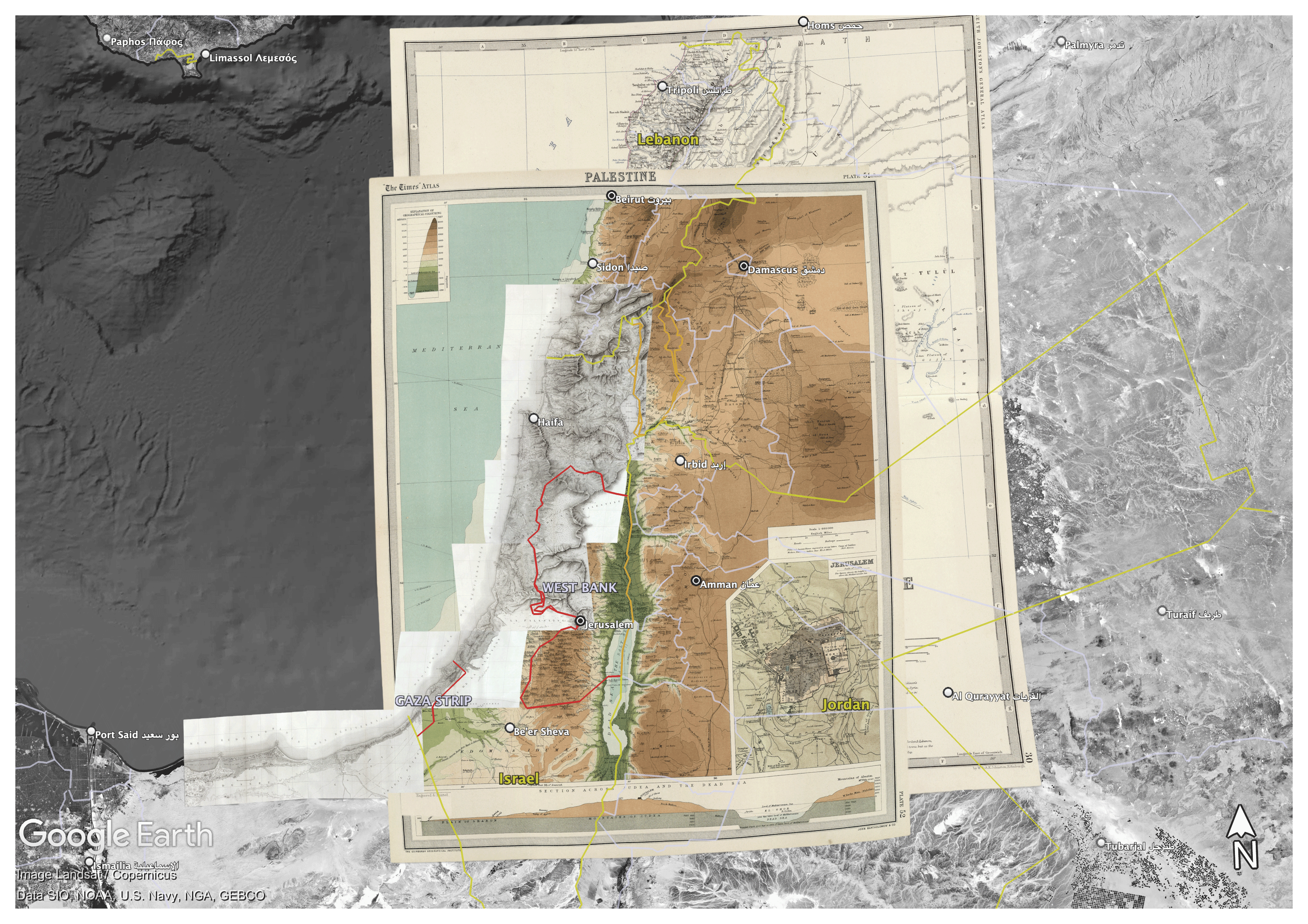
This deliberate overwriting creates a profound cartographic conflict. The map asserts a new, clean script over the older, Lived Space17, leading to the violence inherent in the palimpsest metaphor. The palimpsest concept suggests that while the new, dominant map attempts to erase history, it ensures the co-existence of several different scripts, meaning older maps and histories remain beneath the surface, creating a multivocal cultural landscape18. Palestinian cinema exploits this tension, using the visual field to bring the erased layers back into focus, fighting the ‘Representations of Space’ imposed by the state with the raw power of ‘Representational Space’. The shift in cartographic sovereignty, the transition across registers from Palestine to Israel, was not a punctual event but a gradual, protracted process achieved through cumulative, strategic tactics (fig. 2).
The preceding theoretical discussion establishes the fundamental conflict: the necessity of the contrapuntal palimpsest as a response to the colonial state’s cartographic violence. The following analysis now transitions from abstract theory to methodological application, demonstrating how this framework is actively deployed through specific cinematic compositional strategies. The three films analyzed do not merely document absence; they utilize their structural division, affective mapping, and cinematic language to perform the very theoretical resistance outlined above. Elia Suleiman, in his 1996 feature, Chronicle of a Disappearance, serves as the foundational case, transforming the camera itself into the ultimate tool of spatial resistance, using fragmentation and the extended long take to build a defiant counter-geography out of the domestic, the mundane, and the silent protest of everyday life.
Elia Suleiman’s first feature film documents a diary of restlessness. He traces his return to the West Bank after a long absence, set during the tense period following the assassination of Yitzhak Rabin. The film rejects conventional narrative, utilizing a series of barely connected vignettes and sketches that embody the restlessness and uncertainty associated with Palestinian statelessness. This fragmentation metaphorically reflects the psychological and spatial fragmentation of the homeland itself. The film is structurally divided, shifting between the light, domestic tone of the ‘Nazareth Personal Diary’ and the more ideological ‘Jerusalem Political Diary.’ This oscillation maps the schizophrenia of ‘post-Oslo’ Palestinian life19, where the comfort of a real home with a garden remains difficult to sustain. The challenge of capturing this return is best framed by Calvino’s Aglaura, where the traveler observes the dichotomy between the conceptual city and the physical one:
The city that they speak of has much of what is needed to exist, whereas the city that exists on its site, exists less [...] the recollection of the other, in the lack of words to fix it, has been lost20.
The four vignettes from the ‘Nazareth: Personal Diary’ collectively function as precise cinematic interventions that assert ‘Representational Space’ (Lefebvre’s lived and remembered domain) against the systemic ‘Representations of Space’ (official, colonial order) that seek to erase or defile Palestinian identity21. This is a unified analysis demonstrating how these scenes construct a Contrapuntal Palimpsest.
The Auto Mechanic Scene: The vignette featuring the mechanics, the broken car, and Samira Saïd’s love song ‘Aywa Bashta’alak Sa’at’ is a potent example of affective mapping colliding with mundane Spatial Practice. The scene juxtaposes the gritty, physical reality of manual labor in a dusty garage with the extreme, intimate emotionality of the classical Arabic love song. This dissonance embodies the double-vision of the Palestinian experience: the men see the present here and now (the broken car) simultaneously with the lost object of love and longing (“what has been left behind,” i.e., the whole, sovereign homeland). The car itself becomes a surrogate ground for the wounded nation. By pouring their romantic yearning into the mechanical repair, the men transform an act of maintenance into an act of profound care for the non-material city (fig. 3). The song transforms the mundane workspace into a vibrant ‘Representational Space’ defined by collective memory and political desire, resisting its categorization as mere labor in the official colonial economy.
The discussion of the Nazareth man writing his PhD thesis on ‘How a Man Pees’ relates directly to Calvino’s fragmented geography and the idea of discourse as existence. Calvino’s city, Aglaura, exists more strongly in its discourse than in its physical reality. The men’s discussion of the absurd PhD is a form of discourse that the community takes pride in, asserting a local identity and intellectual sovereignty entirely divorced from political discourse. The city of Nazareth, as a site of free thought, is fixed and preserved by this absurd anecdote, preventing its true essence from being “lost in the lack of words to fix it.” By applying the highest form of intellectual rigor (the PhD) to the most uncontrollable bodily function, the men assert a cultural space that is inherently non-subservient to colonial geometry. It is an absurd, yet vital, declaration that their minds are free, even if their Spatial Practice is restricted.
The Corruption of Sacred Space: The vignette featuring the Orthodox priest (played by Leonid Alexeenko) railing against the pollution of the Holy Land is a direct commentary on the spiritual and physical defilement of the land by global economic forces. The priest’s emotional dialogue creates extreme cognitive dissonance, contrasting the spiritual memory “That’s where Jesus is said to have walked on water” with the profaned, commercialized reality “Now it’s a gastronomic sewer filled with excrement, the shit of American and German tourists who eat Chinese food”. This scene powerfully uses the palimpsest metaphor. The original, sacred script of the holy site is brutally overwritten by a new, vulgar, and transient layer of global commerce and its waste products. The priest defends the ‘Representational Space’ from the corrupting ‘Spatial Practice’, showing that the physical vulnerability of space extends even to the “sacred” domain. Yet beyond its environmental and spiritual critique, the scene performs an act of resistance by restoring visibility to the Christian Palestinian community, a population increasingly marginalized within the dominant discourse of occupation. By foregrounding this forgotten voice, Suleiman reasserts a plural Palestinian identity that extends the struggle beyond a single faith or symbol, revealing a broader human loss embedded in the colonial condition (fig. 4).
Suleiman’s depiction of his own fragmented presence, often silent, always observing, is used to expose the intimate political architecture of occupation and its psychological toll. The spatial elements of his domestic life and his professional pursuits become critical sites for analyzing the limits of Palestinian sovereignty and expression.
The search for a new dwelling in Jerusalem exposes the direct conflict between ethnic identity and the basic right to ‘Spatial Practice’. The scene featuring a Palestinian woman seeking an apartment despite speaking Hebrew well, only to be denied because her identity is revealed by her Arabic name, ‘Aden,’ illustrates the architectural consequence of linguistic and cultural erasure. The housing market, an ostensibly neutral economic zone, becomes a site of colonial segregation, transforming the ‘Representations of Space’ into a denial of Lived Space. The highly competent linguistic performance is rendered irrelevant by the unyielding, foundational power of ethnic identification, establishing that the architecture of ownership is fundamentally exclusionary (fig. 5).
The spatial politics of occupation is acutely rendered when a police patrol, after peeing on a wall (a Spatial Practice of casual domination), accidentally drops a walkie-talkie. This act of profound negligence, dropping the tool of surveillance during a moment of base, human necessity, is a critical cinematic irony. The walkie-talkie becomes a ‘ghost object’ that travels without logic, bridging people who can never truly meet. Elia discovers the device, which becomes his unexpected link to the voice of the oppressor, turning him into a silent monitor of the state’s operations. The military order, typically abstract, suddenly manifests as a physical, faulty object. The narrative choice to transfer the walkie-talkie to the Palestinian woman ‘Aden,’ who was denied housing, is highly symbolic: his means of communication now belongs to another voice of Palestine, perhaps the next generation, or the “other side” of his silence. She actively uses it to disrupt police operations, singing an “overly malevolent version of Israel’s national anthem” over the air, turning surveillance technology into an act of guerrilla theater and political disruption22. Critically, because the film never shows the exchange, it refuses closure or continuity, keeping Palestinian life suspended, fragmented, and unresolved.
The film’s structural split, moving from the light, domestic ‘Nazareth Personal Diary’ to the more ideological ‘Jerusalem Political Diary,’ culminates not in political resolution, but in a final, ironic return to the quiet domesticity of his parents’ home, sealing the meaning of his chronicle.
The Final Layer: Ard al-Mi‘ad, The Promise Land and the Politics of Disappearance: The Conceived Home by Force. The film does not end in Jerusalem but cuts back to the domestic frame in Nazareth. The final scene shows Elia’s mother and father asleep, with all the lights off. The television remains on, displaying a large Israeli flag followed by a Hebrew narration celebrating the Feast of the Tabernacles (Sukkot)23. This image is the final, profound assertion of conceived space imposed by force: the nationalistic and religious spectacle of the dominant power invades the private, vulnerable Palestinian home, the last architectural refuge, while the family sleeps in darkness. The visual message is that surveillance is no longer external but internal; the struggle for space is complete when the ideological architecture of the state is projected onto the living room wall. The film’s chronicle thus ends not with the political climax but with a quiet resignation to this internal invasion, offering a haunting statement on statelessness (fig. 6).
The Last Homeland. The film ends with the dedication, “To my mother and father... the last countryland!!” This frames the domestic sphere (the parents’ home) not just as comfort, but as the final, vulnerable, enduring homeland that survives the political and physical disintegration mapped by the chronicle. The silent, stable presence of his parents is the ultimate counter-archive, the quiet, persistent core of ‘Representational Space’ resisting the surrounding erasure.
Suleiman consistently employs the long take, transforming seemingly mundane scenes into powerful architectural statements of presence and endurance. A key example is the recurring long take of Nazareth balconies (e.g., approx. 00:15:00 in the “Nazareth Diary”). This shot is characterized by a static, unedited camera framed through the same window. Suleiman also uses silence as a powerful political territory, noting that it can be so destabilizing to power structures. By abstaining from didactic excess, the shot allows the spectator to fill in the space. The unchanging frame becomes the most stable architectural boundary, protecting the domestic routine, the continuity of Palestinian life, from the political turbulence outside, emphasizing endurance through stillness.
Annemarie Jacir’s feature debut focuses on Soraya, a Brooklyn-born Palestinian, who travels to her family’s homeland. Her journey is a physical act of traversing the boundary between the diaspora’s abstract, inherited memory of the Nakba and the harsh reality of occupation. Soraya arrives as a voyageur forced to map her ancestral place through corporeal vulnerability. This is immediately evident in the border crossing sequence. Upon arrival, Soraya is immediately dehumanized by customs agents; she is subjected to intrusive searches when they realize she is Palestinian seeking entry to the West Bank. The border checkpoint is rendered as a site of intense affective trauma, where the political structure of control is brutally inscribed upon the individual body, and this is also manifested in other frames of the movie (fig. 7). This sequence establishes that the denial of space begins at the level of the body itself.
The film delves into the economic dimension of spatial erasure. Soraya travels to Jaffa to retrieve her grandfather’s savings, which were frozen in a bank account since his exile in 1948. This financial erasure serves as a barrier of forced absence; Soraya is repeatedly told that she has never been there as a Palestinian with a legal claim to her family’s past assets. Jaffa itself is a profound site of absence, an ancient Palestinian city whose architecture might still be there, but demographics were largely erased during the Nakba. The experience of Soraya in Jaffa aligns with Calvino’s concept of semiotic absence, where the “present” city is overwhelmed by what is lost: “Calvino’s city stands as a metaphor for precisely this kind of semiotic absence, the present city pointing towards that which is ‘not there’ although the city is undeniably ‘not that’, it is undeniably not the absent thing toward which it perpetually points”.
The 'Jaffa' Soraya visits is simultaneously there physically and institutionally, and yet fundamentally ‘not that’, it is not the Jaffa of her grandfather’s memory and entitlement. The bank scene uses sterile, institutional architecture to symbolize systemic control. The ‘frozen account’ symbolizes the freezing of historical time and the prevention of economic capital necessary for rebuilding. The colonial fortress of the bank utilizes bureaucracy to maintain the erasure of Palestinian economic presence, making the present Jaffa perpetually absent to Soraya.
The protagonist’s journey is defined by a dense layering of both visible (physical) and invisible (bureaucratic/ethnic) barriers, demonstrating the omnipresence of ‘Representations of Space’ in controlling Palestinian Spatial Practice. The frustration is twofold: Soraya’s desire to settle in Palestine is restricted by Israel, while her co-protagonist, Emad, finds his desire to leave Palestine similarly thwarted by visa denials. The denial of movement extends beyond the present moment. The film briefly cuts to a commemorative plaque inscribed ‘Palestine 1924’ (approx. 00:57:06). This moment is crucial, as the inscription itself embodies a palimpsestic effect, a layered reminder that it was Palestine. By flashing back to the year 1924, the film asserts that the present bureaucratic denial (the bank, the visa office) is not an anomaly but the contemporary consequence of systematic historical violence, linking the contemporary trauma directly to the colonial precedents of the Mandate era.
The journey across occupied territory is mapped by constant friction. Emad and Soraya encounter physical checkpoints, visible barriers of steel bars, concrete walls in streets, and barbed wires, which are manifestations of the state’s ‘Representations of Space’. Dialogue, such as ‘entazer hona 7agez amamak’ (or “wait here, a checkpoint is ahead”), underscores the fact that movement in the heritage cities is not fluid but occurs in fragmented, controlled segments, where the car, a symbol of transient freedom, is constantly subject to the military’s will, reinforcing the difficulties of reclaiming space through vehicular motion.
The climax of their unauthorized journey into Israel is the visit to Soraya’s ancestral house in Jaffa, a key site of memory and identity. The house is physically present but politically ruined (approx. 1:08:00). Soraya and Emad risk arrest to visit the property, which is now occupied by a liberal Israeli woman, Irit. Soraya insists they drop the pretense of polite behavior and demands recognition of her family’s claim, illustrating the political impossibility of coexistence without recognition. The cinematic gaze lingers on architectural details, colorful tiles and doorframes, using these remnants to assert the history of Palestinian lived experiences (‘Representational Space’) against the current occupancy. The house, though physically standing, is perceived as completely ruined by Soraya because it has been stripped of its ancestral function and memory; it has become the absent thing toward which it perpetually points. This moment of confrontation, which involves Soraya asserting her lived memory over the occupier’s passive opposition to the terrible situation of violence, is the film’s attempt at reclaiming the architectural function of the home: a site of belonging (fig. 1). This impulse extends to the idea that ruins could go back if the real people used it, a philosophy embodied in their dangerous, illegal journey to places like 'Duwaima', where the literal occupation of the land (even temporarily) is the only true act of Spatial Practice left. The sheer symbolic weight of Soraya’s visit remains crucial to the presentation and preservation of this contested site of memory, irrespective of the property’s legal status.
The third layer is a bit different and will be briefly addressed, as it is a documentary, so it is another kind of cinematic space. Five Broken Cameras offers a deeply personal, first-hand account of life and nonviolent resistance in 'Bil’in', a West Bank village targeted by the construction of the Israeli Separation Barrier. The Wall is the physical manifestation of the colonial state’s ‘Representations of Space’, a planned, monolithic structure designed to consume cultivated village land and support expanding settlements such as 'Modi’in Illit'. This architecture functions as a vast, decentralized Panopticon, echoing Jeremy Bentham’s design as described by Michel Foucault. The intentional vulnerability imposed by the architectural structure ensures that residents feel constantly visible, modifying their behavior under surveillance. The sheer materiality of the concrete, which contemporary Palestinian artists have used critically as a material of resistance, is here inverted by the state, which uses it to impose immobility, separation, and control over Spatial Practice’.
The resulting architectural fragmentation of Bil’in is mirrored in Calvino’s description of Armilla:
Whether Armilla is like this because it is unfinished or because it has been demolished, whether the cause is some enchantment or only a whim, I do not know. The fact remains that it has no walls, no ceilings, no floors: it has nothing that makes it seem a city, except the water pipes that rise vertically where the houses should be and spread out horizontally where the floors should be: a forest of pipes that end in taps, showers, spouts overflows24.
Like Armilla, the village of Bil’in is rendered structurally incomplete, lacking the fundamental architectural stability (“walls, no ceilings, no floors”) due to constant threats of demolition and land appropriation by the expansion of the neighboring settlement. The community must continue its existence amidst a fragmented, contested landscape. The film is structurally organized around the lifespan of five cameras, each damaged or destroyed by soldiers or settlers during the resistance. This object, operated by Palestinian farmer Emad Burnat, is not a detached observer; it is the ultimate, fragile architectural vessel of Bil’in’s ‘Representational Space’.
Burnat’s cinematography utilizes the immediacy of this hand-held camera to capture the dynamic Spatial Practice of resistance during the weekly protests. The co-direction by Israeli filmmaker Guy Davidi further manifests Said’s contrapuntal method, providing a double perspective on the conflict. Furthermore, the narrative thread tracking the growth of Burnat’s son, Gibreel, in the shadow of the Wall functions as a critical emotional cartography. It links the monumental geopolitical conflict to the innocent, intimate space of childhood development, mapping the trauma of conflict onto the emotional landscape of the next generation.
The analysis of Chronicle of a Disappearance, Salt of This Sea, and the brief analysis and overview of Five Broken Cameras demonstrates that Palestinian cinema fundamentally shifts the operative definition of architecture in a heritage city. In this context, where building is often forbidden and denial is systematic, architectural work moves from material construction to the resilient construction of visual memory and defiance.
These films utilize the camera frame as a precise, architectural tool for resistance. Suleiman constructs silent, enduring frames of domesticity; Jacir maps the affective trajectory of return through bodies, barriers, and institutions; and Burnat and Davidi construct a physically scarred, yet ultimately indestructible, visual record of resistance against monumental structures of control through the eye of an ‘object’. Indeed, three objects guided this study: the walkie-talkie, the barrier, and the camera, each more liberated and enduring than the people who once held them. Objects, even when fractured, remain as witnesses; people, under the weight of exile, are often forced to vanish. Yet the heritage city lives, and lives in layers, its memory sedimented through these and other films; its presence continues to rebuild in the overlapping frames of remembrance and return.
Suleiman’s Chronicle of a Disappearance utilized Said’s double vision by contrasting the romantic idea of return with bureaucratic reality, applying the long take to define Lefebvre’s ‘Representational Space’ (silence as political territory), and echoing Calvino’s Aglaura, the city existing only in discourse, to map interior unrest onto domestic sites such as the Nazareth balconies. Jacir’s Salt of This Sea engaged dissonance by juxtaposing inherited Nakba memory with contemporary denial, converting the act of physical transgression into a revolutionary Spatial Practice against state law. This film thus manifests the semi-absent city that perpetually points toward “that which is ‘not there’,” mapping border crossing trauma and displacement onto the body of the protagonist, Soraya. Finally, Burnat and Davidi’s Five Broken Cameras demonstrated Said’s duality through co-direction, confronting the monolithic ‘Representations of Space’ (the Wall) with the Lived Space of protest, paralleling Calvino’s Armilla, where the city is fragmented and unbuilt, thereby linking the trauma of conflict to the emotional landscape of childhood through Gibreel’s growth.
In Chronicle of a Disappearance, the recurring long take on domestic architecture functions as a visual assertion of silence and endurance within ‘Representational Space’. In contrast, Salt of This Sea employs static mid-shots and a sterile, bureaucratic interior during the Jaffa Bank negotiation, thematically linking the institutional architecture to the denial of the financial archive, thereby cementing economic erasure as spatial dispossession. The final layer, Five Broken Cameras, deployed wide shots and the hand-held camera during the weekly protest confrontations to capture the visual battle between the massive, conceived geometry of the Separation Barrier and human Spatial Practice. Furthermore, the physical destruction of the camera itself is translated through quick, fragmented cuts and a sudden shift to black, functioning metaphorically as the physical violation of the counter-archive, the camera as a martyr to truth, echoing Kracauer’s theory of shock and fragmentation.
The practice of cinematic urbanism, utilizing the contrapuntal palimpsest, ensures that ruins and fragments are denied the status of endings. Instead, they are perpetually reassembled through the rhythm, cut, and gaze of the filmmaker. This mechanism transforms the act of viewing into an active political engagement.
What emerges from this cinematic effort is not a restoration of the city but a radical reimaging of it, one where the multiple narratives, memories, and absences remain suspended, discordant, and alive. By creating this resilient, fragment-based cinematic urbanism, these filmmakers ensure that while reconstruction may often be forbidden, and even the name “Palestine” must be defended, narration endures. And through that enduring narration, the city is not only remembered, but perpetually rebuilt in vision.
The city, however, does not tell its past, but contains it like the lines of a hand, written in the corners of the streets, the gratings of the windows, the banisters of the steps, the antennae of the lightning rods, the poles of the flags, every segment marked in turn with scratches, indentations, scrolls25.
As Calvino reminds us through Zaira in his Invisible Cities, Palestinian cinema becomes the hand that traces the invisible lines of the heritage city, not to reconstruct what was lost, but to let this city speak again through its silences, absences, and remembered gestures.
notes
Khalidi, Walid. 2008. "The Arab Perspective." In The Israel–Arab Reader: A Documentary History of the Middle East Conflict, 7th ed., edited by Walter Laqueur and Barry Rubin, 35-42. New York: Penguin.
Migdal, Joel S. 1980. "The Question of Palestine, by Edward W. Said." Political Science Quarterly 95, no. 4: 726-727, https://doi.org/10.2307/2150647.
Examples include Lydda (al-Lydd), Jaffa, Imwas, and Yalu, cities and villages that were renamed, demolished, or removed from contemporary state cartographies following 1948. See also Khalidi, Rashid. 2010 updated ed. Palestinian Identity: The Construction of Modern National Consciousness. New York: Columbia University Press, 231-254.
Makdisi, Saree. 2008. Palestine Inside Out: An Everyday Occupation. New York: W. W. Norton & Company, 83-101.
Said, Edward W., and Liz Gill. 1994. Representations of the Intellectual. New York: Vintage. https://openlibrary.org/books/OL1080460M/Representations_of_the_intellectual.
Weizman, Eyal. 2007. Hollow Land: Israel's Architecture of Occupation. London: Verso Books, 135-158.
Schmid, Christian. 2022. Henri Lefebvre and the Theory of the Production of Space. London: Verso Books.
Kracauer, Siegfried. 1960. Theory of Film: The Redemption of Physical Reality. London: Oxford University Press, 25-26. See also Callenbach, Ernest. 1960. “Kracauer's Film Theory: The Redemption of Physical Reality.” Film Quarterly 14, no. 1 (Autumn): 28-34.
Bruno, Giuliana. 2003. "Atlas of Emotion: Journeys in Art, Architecture, and Film." Choice Reviews Online 40, no. 05: 40-2573, https://doi.org/10.5860/choice.40-2573.
Wilson, George M. 1994. "Edward Said on Contrapuntal Reading," Philosophy and Literature 18, no. 2: 265-273, https://doi.org/10.1353/phl.1994.0025.
Hopkins, Keith, and W. F. Wertheim. 1965. "East-West Parallels: Sociological Approaches to Modern Asia." British Journal of Sociology 16, no. 4: 383, https://doi.org/10.2307/589177.
Calvino, Italo. 1972. Le città invisibili. Torino: Einaudi, 15. The English translation is by Weaver, William. 1974. Invisible Cities. New York: Harcourt Brace, 11.
Dean, Lee R. 2014. "Architectural Drawings are Supposed to Demonstrate the Process." Life of an Architect.
Hannah, Matthew G. 2014. "Beyond the Problem of Blank Pages: Critical Cartography." Journal of Cartography and Geographic Information Science 41, no. 1.
Lambert, Léopold. 2012. "Architecture is Indeed One of the Disciplines that Can Simultaneously Invent New Relations of Power." The Funambulist Pamphlets: Foucault.
Scott, James C. 1998. Seeing Like a State: Why Certain Schemes to Improve the Human Condition Have Failed. New Haven: Yale University Press.
Harley, John B. 2001. The New Nature of Maps: Essays in the History of Cartography. Johns Hopkins University Press.
Schein, Richard. 1997. "The Palimpsest as a Metaphor for Cultural Landscapes." Annals of the Association of American Geographers 87, no. 4: 662.
The post-Oslo period (following the Oslo Accords signed in 1993) is characterized by increased geopolitical fragmentation and an ambiguous political future for Palestinians, a phase described as one of intensified fragmentation, enclosure, and everyday negotiation under occupation. See, for instance, Makdisi, Saree. 2008. Op. cit. and Khalidi, Rashid. 2010 updated ed. Op. cit., 231-254.
"La città che dicono ha molto di quel che ci vuole per esistere, mentre la città che esiste al suo posto, esiste meno [...] E anche a me che vorrei tener distinte nella memoria le due città, non resta che parlarti dell'una, perché il ricordo dell'altra, mancando di parole per fissarlo, s'è disperso." Excerpt from Calvino, Italo. 1972. "Le città e il nome. 1. Aglaura." In Le città invisibili. Torino: Einaudi, 36-37. English translation by William Weaver in Invisible Cities.
Suleiman, Elia. 2019. "On Silence: Silence Itself Actually Has a Site that is so Undefined." Interview quoted in Journal of Palestine Studies 48, no. 4.
Guerrilla theater is a form of political protest that presents unannounced, politically or socially motivated performances in public spaces for an unsuspecting audience.
The Feast of the Tabernacles (Sukkot) is a Jewish festival coinciding with the harvest. The temporary dwellings (tabernacles or tents) remind participants of the 40-year sojourn in the wilderness, symbolizing God's provision.
"Se Armilla sia così perché incompiuta o perché demolita, se ci sia dietro un incantesimo o solo un capriccio, io lo ignoro. Fatto sta che non ha muri, né soffitti, né pavimenti: non ha nulla che la faccia sembrare una città, eccetto le tubature dell'acqua, che salgono verticali dove dovrebbero esserci le case e si diramano dove dovrebbero esserci i piani: una foresta di tubi che finiscono in rubinetti, docce, sifoni, troppopieni." Excerpt from Calvino, Italo. 1972. "Le città sottili. 3. Armilla." In Le città invisibili. Torino: Einaudi, 22-23. English translation in Invisible Cities.
"Ma la città non dice il suo passato, lo contiene come le linee d'una mano, scritto negli spigoli delle vie, nelle griglie delle finestre, negli scorrimano delle scale, nelle antenne dei parafulmini, nelle aste delle bandiere, ogni segmento rigato a sua volta di graffi, seghettature, intagli, svirgole." Excerpt from Calvino, Italo. 1972. "Le città e la memoria. 3. Zaira." In Le città invisibili. Torino: Einaudi, 10-11. English translation in Invisible Cities.
Edited by: Sofia Celli (Politecnico di Milano), Davide Del Curto (Politecnico di Milano), Elena Fioretto (Politecnico di Milano) and Elena Pozzi (Ministero della Cultura)
Alessio Battistella
Luka Skansi
Heather Clydesdale