

 essays

reviews by the editorial staff
FOUNDER
Federico Bucci
DIRECTOR
Elisa Boeri
DEPUTY DIRECTOR
Elena Fioretto and Claudia Tinazzi
SCIENTIFIC COMMITTEE
Ángela García de Paredes, Jean-Philippe Garric, Ana Tostões, Elisa Valero Ramos, Bianca Gioia Marino, Andrea Sciascia, Filippo Lambertucci, Chris Whitehead
EDITORIAL BOARD
Samanta Bartocci, Luca Cardani, Luciana Macaluso, Lorenzo Mingardi, Beatrice Moretti, Elena Pozzi, Rosa Sessa
EDITORIAL STAFF
Alessandro Benetti, Alberto Bologna, Federica Causarano, Annalucia D’Erchia, Francesca Giudetti, Fabio Marino, Martina Meulli, Michela Pilotti, Sofia Celli, Giorgio Danesi, Roberta Folgiero, Lino Cabras
PHOTO BY
ARCò, Ibrahim Berisha, Alba Marcela Britez Cordoba, Heather Clydesdale, GRACE, Giuseppe Gradella, Armin Linke, Roland Halbe, Alexey Naroditsky, Roberto Saez, Luka Skansi, Uppsala Conflict Data Program UCDP, Guy Welborne
ARCHIVE
IUAV Archivio Progetti - Andrea Bruno Collection
ISSUE N.4
Heritage Cities and Conflicts December 2025
Edited by Sofia Celli (Politecnico di Milano), Elena Fioretto (Politecnico di Milano), Elena Pozzi (Ministero della Cultura)
ISSN
2974-8216
Periodicity
Biannual Magazine
Code of Ethics
The full version of the ADH Journal code of ethics is available at this link.
Editorial guidelines
The submission of abstracts and the entire paper submission process takes place via the ADH Journal platform. The editorial guidelines, provided during the paper submission, are also available at this link.
Referee
ADH Journal subjects published contributions to a double-blind peer review process. The journal employs suitable reviewers to assess contributions for publication based on their background and specific research. The journal\'s editors may decide not to submit the text for review by the referees because it does not meet the editorial line of the issue (not scientifically rigorous or not legally acceptable). The judgments of the referees are promptly sent to the authors of the selected contributions.
The list of reviewers of ADH Journal is available at this link.
Printed and Published by
Publi Paolini
Via R. Zandonai 9
46100, Mantova
Contacts
Politecnico di Milano, Polo Territoriale di Mantova
Piazza D’Arco 3, 46100 Mantova
Graphic layout
ParcoStudio - Milano
“There is a mantra that runs through the European Union, an unwavering agreement that unites, without exception, the states that compose it. Divided on (almost) everything, they are united on one point: to limit the entry of migrants into the territory of the Union as much as possible, to close and protect the borders” (p. 11, eng. trans.).
This is how Chiusi Dentro. I campi di confinamento nell’Europa del XXI secolo (eng. trans.: Locked In: the Confinement Camps in 21st Century Europe) opens in Livio Pepino’s preface L’eclissi del diritto (eng. trans.: The Eclipse of Rights), introducing without filters one of the most controversial aspects of contemporary Europe: the systematic construction of confinement spaces for refugees and migrants on the margins of borders or in the heart of the continent. The book analyses the process and methods through which the European Union institutionalises and manages reception and detention facilities, designed to control migration flows and the daily life of individuals, who are progressively deprived of their freedom and reduced to a condition of “non-persons”. The title itself expresses a clear critical intent, highlighting the central role of the spatial dimension in the contemporary conflict between Europe and migration.
The book is divided into two sections. The first provides an overview of confinement camps and how access to Europe is managed, while the second analyses the countries most affected by migration and the policies promoted by the European Union for the construction of control structures. In particular, the contributions in the first section examine the political, legal, administrative and organisational mechanisms that make possible the increasingly consolidated phenomenon of the institutionalisation of the “camp system”. Through references to European codes, pacts and regulations, as well as to the international organisations involved - including the two United Nations agencies IOM and UNHCR, and Frontex - the book reveals a shared strategy aimed at governing migrant mobility within and outside European territories through a complex system of detention, identification and reception. In particular, Gianfranco Schiavone’s contribution, Il sistema dei campi di confinamento (eng. trans.: The System of Confinement Camps), identifying the morphological characteristics of the camps, offers a detailed description of their architectural and spatial design, demonstrating how architecture is actively involved in the contemporary policies of confinement of migrants and refugees. As described by the author himself, the camp has a very specific architectural form, characterised by a “semi-detention nature” determined mainly by three factors: the isolation of the location in which the camp is built, the social segregation from the outside world, and the rigid organisation of the daily life of the confined individuals. In almost all cases, the camps are located in isolated, inaccessible areas, surrounded by walls, multiple boundary fences and permanently guarded entry points that limit freedom of movement and the possibility of contact with the outside (p. 44).
The second section, Campi, Paesi, Confinamento (eng. trans.: Camps, Countries, Confinement), examines a series of emblematic country-cases. The analysis encompasses both European Union member states - Greece, Italy, Poland, Lithuania and Latvia - and non-EU countries - Turkey, North Macedonia, Serbia and Bosnia and Herzegovina - as well as the border area between Belarus and Poland. Particular attention is paid to the role of non-EU countries which act as filter countries along the main migration routes: through European funding and specific agreements between states - such as the 2016 EU-Turkey agreement - these countries have built camps and detention facilities aimed at “externalising” borders and “alleviating” migratory pressure in Europe.
The book is published by Rivolti ai Balcani, a network that has been active since 2019 in promoting research on what is happening along European borders and on the conditions of migrants in transit, particularly along the Balkan route. Chiusi Dentro. I campi di confinamento nell’Europa del XXI secolo (eng. trans.: Locked In: the Confinement Camps in 21st Century Europe) is an important result of this research: in just a few pages and through an interdisciplinary approach that integrates economics, finance, politics, sociology, ethics and architecture, the book summarises the complexity of the migration phenomenon. In line with the book, the multimedia project Chiusi Dentro. Dall’alto (eng. trans.: Locked In. From Above), produced in collaboration with Altraeconomia and PlaceMarks, shows the territorial impact of detention camps and their layout through satellite photographs and maps, stimulating critical reflection on the role of architecture in the shaping of contemporary spaces of exclusion.
The researches demonstrate Europe’s tendency to implement generalised policies of hostility towards the migrant population, aimed at creating invisible and remote “non-places”, governed by prohibitions and characterised by control and rejection. In this scenario, architecture acts as a device of power that generates a separation between “inside” and “outside”, revealing an uninterrupted logic of segregation of the “other” in structure with a “concentrationary nature”. Thus, in the contemporary conflict between Europe and migration, architecture becomes a key “element of erosion” of fundamental human rights. By recalling Article 13 of the 1948 Universal Declaration of Human Rights, according to which “Everyone has the right to freedom of movement and residence within the borders of each State” (p. 137), and referring to the reflections of sociologist Federico Rahola, the book reaches a critical and explicit conclusion: migrant confinement camps are the “detention machine” of 21st century Europe (p. 39).
Chiusi Dentro. I campi di confinamento nell’Europa del XXI secolo
RiVolti ai Balcani
Altraeconomia Edizioni
Milan
2024
13 x 20 x 2,5 cm
312 pages
Italian
9788865165034


Photos of “Chiusi Dentro. I campi di confinamento nell’Europa del XXI secolo” edited by Rivolti ai Balcani


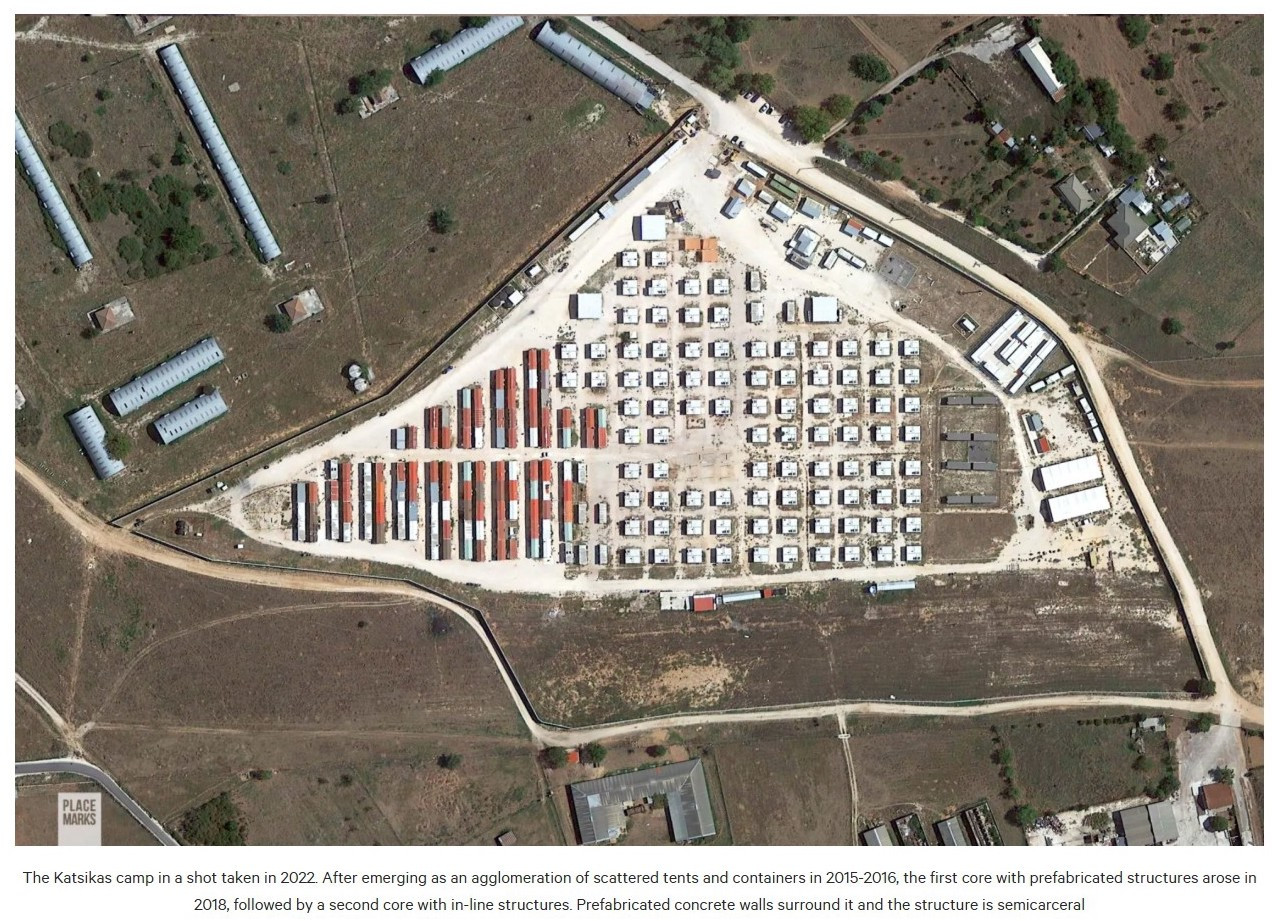
Photos of the website “Chiusi Dentro. Dall’alto” by Rivolti ai Balcani, Altraeconomia and PlaceMarks

