essays

reviews by the editorial staff
FOUNDER
Federico Bucci
DIRECTOR
Elisa Boeri
DEPUTY DIRECTOR
Elena Fioretto and Claudia Tinazzi
SCIENTIFIC COMMITTEE
Ángela García de Paredes, Jean-Philippe Garric, Ana Tostões, Elisa Valero Ramos, Bianca Gioia Marino, Andrea Sciascia, Filippo Lambertucci, Chris Whitehead
EDITORIAL BOARD
Samanta Bartocci, Luca Cardani, Luciana Macaluso, Lorenzo Mingardi, Beatrice Moretti, Elena Pozzi, Rosa Sessa
EDITORIAL STAFF
Alessandro Benetti, Alberto Bologna, Federica Causarano, Annalucia D’Erchia, Francesca Giudetti, Fabio Marino, Martina Meulli, Michela Pilotti, Sofia Celli, Giorgio Danesi, Roberta Folgiero, Lino Cabras
PHOTO BY
ARCò, Ibrahim Berisha, Alba Marcela Britez Cordoba, Heather Clydesdale, GRACE, Giuseppe Gradella, Armin Linke, Roland Halbe, Alexey Naroditsky, Roberto Saez, Luka Skansi, Uppsala Conflict Data Program UCDP, Guy Welborne
ARCHIVE
IUAV Archivio Progetti - Andrea Bruno Collection
ISSUE N.4
Heritage Cities and Conflicts December 2025
Edited by Sofia Celli (Politecnico di Milano), Elena Fioretto (Politecnico di Milano), Elena Pozzi (Ministero della Cultura)
ISSN
2974-8216
Periodicity
Biannual Magazine
Code of Ethics
The full version of the ADH Journal code of ethics is available at this link.
Editorial guidelines
The submission of abstracts and the entire paper submission process takes place via the ADH Journal platform. The editorial guidelines, provided during the paper submission, are also available at this link.
Referee
ADH Journal subjects published contributions to a double-blind peer review process. The journal employs suitable reviewers to assess contributions for publication based on their background and specific research. The journal\'s editors may decide not to submit the text for review by the referees because it does not meet the editorial line of the issue (not scientifically rigorous or not legally acceptable). The judgments of the referees are promptly sent to the authors of the selected contributions.
The list of reviewers of ADH Journal is available at this link.
Printed and Published by
Publi Paolini
Via R. Zandonai 9
46100, Mantova
Contacts
Politecnico di Milano, Polo Territoriale di Mantova
Piazza D’Arco 3, 46100 Mantova
Graphic layout
ParcoStudio - Milano
Russia’s invasion of Ukraine on 24 February 2022 marked a point of no return in the increasingly tense relationship between the two countries, which had already deteriorated following the outbreak of the conflict in 2014. The most immediate and painful consequences of the war are the casualties on both sides of the frontline; however, its long-term devastation will be most profoundly described by the destruction of the built environment. In February 2025, the Kyiv School of Economics published a report estimating damage to approximately 236000 residential buildings, 1550 healthcare facilities, 4000 educational institutions, and 3900 cultural sites. Beyond the destruction of civilian infrastructure, the deliberate targeting of Ukrainian national identity is evident in UNESCO statistics published in December 2025, which list 268 buildings of historical or artistic significance damaged or completely destroyed since the beginning of the war.
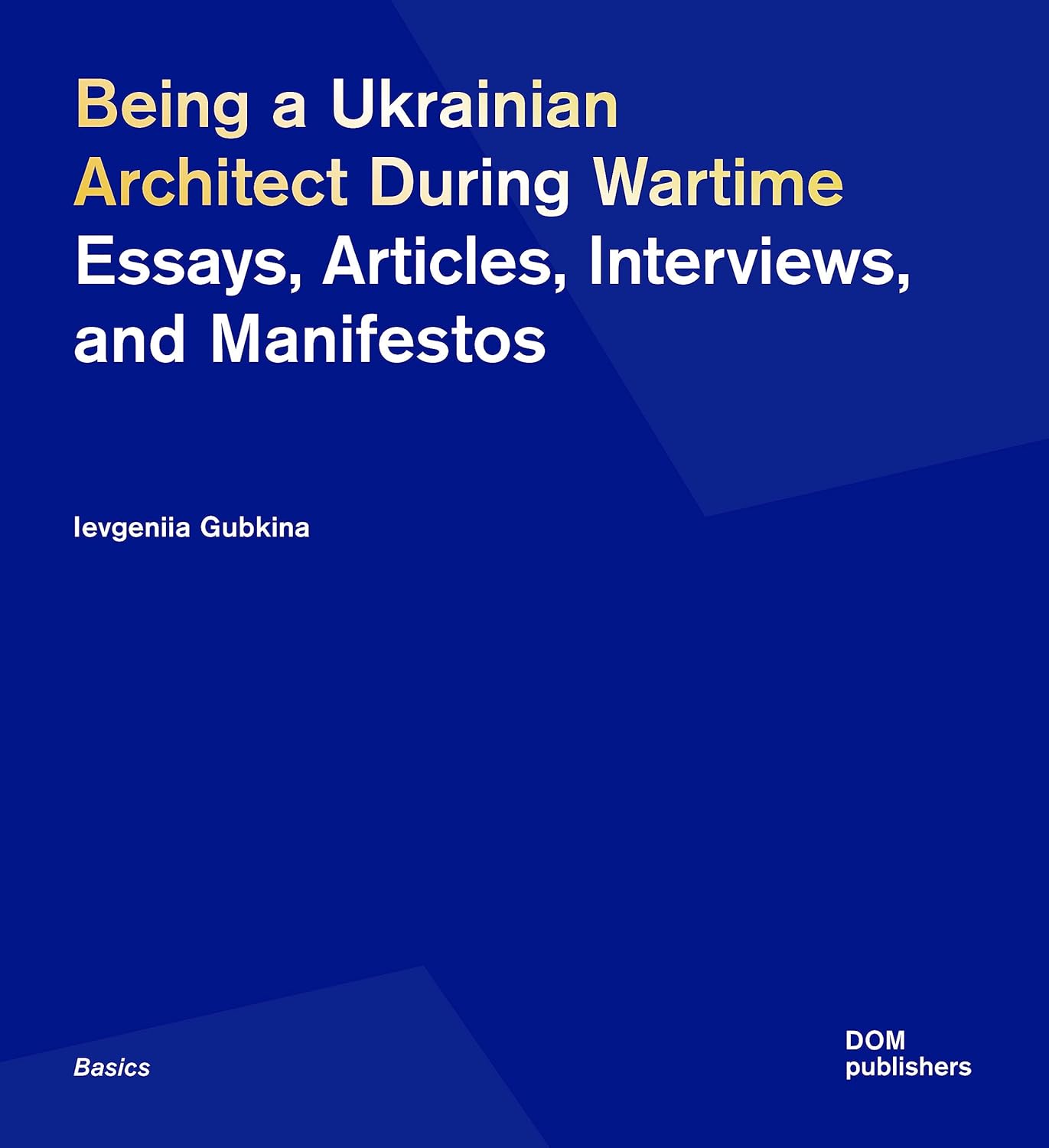
In the middle of such destruction, what is the role of the architects? Should architects remain on the ground to protect heritage, speak out on international platforms, envision post-war reconstruction while cities are still under attack, or urgently document architectural heritage while it is still standing? Many of these questions are raised and addressed in Being a Ukrainian Architect During Wartime by Ievgeniia Gubkina, a book that is rather a personal testimony and a political manifesto then conventional scholarly narration of the unfolding events. It assembles, in chronological order, Gubkina’s articles, speeches, and interviews produced during the first months of the invasion.
Ievgeniia Gubkina is a Ukrainian architect and architectural and urban historian who was forced into exile following the outbreak of the full-scale war. Her work focuses on twentieth-century Ukrainian architecture and combines scholarly research with curatorial practice and activism. This background, intensified by personal wartime experience, conditioned her to assume the role of an architectural war correspondent, responding to unfolding events while addressing the interests and expectations of an international audience.
Throughout the texts, Gubkina articulates a direct and uncompromising position, framing architecture as “perhaps the most social and one of the most political types of activity” (p. 39). She situates heritage as an active political field rather than a neutral repository of the past. From this perspective, the deliberate targeting of heritage constitutes a political act that contributes to the erasure of collective memory and the mutilation of national identity. “Architecture Is Not Walls, It Is People”, the slogan of the multimedia project Encyclopedia of Ukrainian Architecture curated by Gubkina in 2020, can also be read as a central argument of this book. The author reconstructs the affective and physical ties between people and heritage during wartime, observing that “people protect heritage, shelter inside it, die inside or at it, document it, grieve for it and strive for its restoration” (p. 127). In this context, heritage does not represent mere relics of the past; rather, its safeguarding becomes an expression of national resistance and a commitment to carry testimonies of collective memory into the future.
In the interviews with Gubkina, the recurring tendency to move quickly from acknowledging ongoing destruction to envisioning post-war reconstruction is evident; often it is accompanied by an eagerness within the professional community to intervene and offer solutions from outside. While she acknowledges that such discussions may help society “heal and grow in the face of the huge trauma we are experiencing” (p. 68) and foster national resilience, she insists that reconstruction entails a profound moral responsibility toward a deeply traumatized society. As she cautions, “if we also contribute to the demolition of that [destroyed] heritage and forget it, or if we use the wartime destruction to fulfil our own architectural fantasies, that would not be in the public interest” (p. 84). Post-war reconstruction, she argues, will require new modes of administrative decision-making grounded in public participation and solidarity, as well as collaboration among a broad spectrum of professionals - from conservative restorers to visionary planners and architects. International involvement in Gubkina’s opinion is welcomed insofar as external actors are willing to work in partnership with Ukrainian society rather than executors of their own ambitions.
Through its divers forms of expression, the book conveys a manifesto of an architect deeply concerned with the unprecedented scale of destruction - not only of the built environment, but of the historical and cultural foundations of the nation to which she belongs. The book may be criticised for its directness, emotional intensity, or limited analytical distance. However, Gubkina addresses such concerns in the introduction, noting that “war leaves no luxury of deliberation, no margin for mistake, no room for multiple rounds of discussion and debate, doubt, and explanation” (p. 8). She further acknowledges that more analytical and reflective work may emerge in the aftermath of the war. For the present moment, however, the reader is offered an emotionally charged testimony - one that speaks not only for a single architect, but for a nation confronting the ongoing violence of war.
Being a Ukrainian Architect During Wartime. Essays, Articles, Interviews, and Manifestos
Ievgeniia Gubkina
DOM publishers
Berlin
2023
21 x 23 cm
167 pages
English


Photos from Ievgeniia Gubkina, Being a Ukrainian Architect During Wartime, 2023