essays

reviews by the editorial staff
FOUNDER
Federico Bucci
DIRECTOR
Elisa Boeri
DEPUTY DIRECTOR
Elena Fioretto and Claudia Tinazzi
SCIENTIFIC COMMITTEE
Ángela García de Paredes, Jean-Philippe Garric, Ana Tostões, Elisa Valero Ramos, Bianca Gioia Marino, Andrea Sciascia, Filippo Lambertucci, Chris Whitehead
EDITORIAL BOARD
Samanta Bartocci, Luca Cardani, Luciana Macaluso, Lorenzo Mingardi, Beatrice Moretti, Elena Pozzi, Rosa Sessa
EDITORIAL STAFF
Alessandro Benetti, Alberto Bologna, Federica Causarano, Annalucia D’Erchia, Francesca Giudetti, Fabio Marino, Martina Meulli, Michela Pilotti, Sofia Celli, Giorgio Danesi, Roberta Folgiero, Lino Cabras
PHOTO BY
ARCò, Ibrahim Berisha, Alba Marcela Britez Cordoba, Heather Clydesdale, GRACE, Giuseppe Gradella, Armin Linke, Roland Halbe, Alexey Naroditsky, Roberto Saez, Luka Skansi, Uppsala Conflict Data Program UCDP, Guy Welborne
ARCHIVE
IUAV Archivio Progetti - Andrea Bruno Collection
ISSUE N.4
Heritage Cities and Conflicts December 2025
Edited by Sofia Celli (Politecnico di Milano), Elena Fioretto (Politecnico di Milano), Elena Pozzi (Ministero della Cultura)
ISSN
2974-8216
Periodicity
Biannual Magazine
Code of Ethics
The full version of the ADH Journal code of ethics is available at this link.
Editorial guidelines
The submission of abstracts and the entire paper submission process takes place via the ADH Journal platform. The editorial guidelines, provided during the paper submission, are also available at this link.
Referee
ADH Journal subjects published contributions to a double-blind peer review process. The journal employs suitable reviewers to assess contributions for publication based on their background and specific research. The journal\'s editors may decide not to submit the text for review by the referees because it does not meet the editorial line of the issue (not scientifically rigorous or not legally acceptable). The judgments of the referees are promptly sent to the authors of the selected contributions.
The list of reviewers of ADH Journal is available at this link.
Printed and Published by
Publi Paolini
Via R. Zandonai 9
46100, Mantova
Contacts
Politecnico di Milano, Polo Territoriale di Mantova
Piazza D’Arco 3, 46100 Mantova
Graphic layout
ParcoStudio - Milano
Over the last thirty years, Taiwan has cultivated a vibrant architectural scene. One exemplary project, the Beitou Branch of the Taipei Library designed by Bioarchitecture Formosana, broke new ground in sustainable construction and fashioned aesthetics that connected people to the local topography and historical legacies. Yet the building’s achievement extends beyond launching a design trend. The real feat was in forging a paradigm that can strengthen social trust and galvanize civic values.
This article examines the Beitou paradigm, along with other projects that interpret it within different contexts across Taiwan, to demonstrate the potency of architecture that is positioned strategically in environmental, historical, social, and civic landscapes. It considers these projects as manifestations of Kenneth Frampton’s Critical Regionalism and, through the lens of political theories shaped by Alexandre Lefebvre and John Rawls, among others, suggests how architecture can constitute a “colloquial expression of liberal democracy.” It concludes that Taiwanese library architecture promulgates “common sense” among visitors, which in turn strengthens civic values. Connecting this to findings in neuroarthistory and neuroscience shows that architecture can be surprisingly active in determining how people discern and evaluate information, and in shaping feelings, decisions, or actions that ensue. Buildings can play a crucial role as concrete mediators of a shared reality to help individual citizens and the social body cope with misinformation. This is especially germane to the government and citizenry of Taiwan as they face the specter of conflict with the People’s Republic of China (PRC), which considers Taiwan to be a renegade province, and is targeting Taiwan with a sustained campaign of cognitive warfare. More generally, the Beitou paradigm indicates how public architecture can strengthen social cohesion and bolster civic resilience in democratic societies.
Over the last thirty years, Taiwan, an island off of China’s east coast, has established a thriving liberal and pluralistic society and built an advanced economy, the crown-jewel of which is its semiconductor industry. In that same period, the government has invested in local infrastructure and community projects, cultivating a vibrant architectural scene. One exemplary project is the Beitou Branch of the Taipei Library (Taibeishi Beitou li tushuguan fenguan 台北市立圖書館北投分館). This library broke new ground in sustainable construction and operations. Additionally, its aesthetics rooted the structure in the local topography and historical legacies while fostering individual exploration and community connections. Yet the building’s achievement extends beyond launching a design trend. The real feat was in forging a paradigm that strengthens social trust and galvanizes civic values.
This is especially germane to the government and people of Taiwan as they face the specter of conflict with the People’s Republic of China (PRC), which considers Taiwan to be a renegade province. In addition to amassing forces for a possible invasion, the PRC is targeting Taiwan with a sustained campaign of cognitive warfare, which leverages neuroscience to assail the mindset and undermine the will of a population1. This article argues that the Beitou library formed a new paradigm, and that libraries built subsequently in Taiwan demonstrate its potency. These libraries show how architecture can act as a sieve to filter and mediate individual’s cognitive experiences while negotiating and promulgating civic values among the local population. Findings in neuroarthistory and discoveries in neuroscience show that architecture can be surprisingly active in determining how people discern and evaluate information, and in shaping feelings, decisions, or actions that ensue. This can help individual citizens and the social body cope with misinformation and even withstand cognitive warfare attacks. The Beitou paradigm shows how public architecture can play a crucial role in democracies and liberal societies.
With the opening of the Beitou library in 2006, the firm Bioarchitecture Formosana (BaF; Jiu dian 九典) introduced new principles for library architecture in Taiwan. They designed a wedge-like structure that responds intuitively to the flow of the creek splicing through the surrounding park (fig. 1). The library is built of cedar and hokulite (Beitou shi 北投石), a stone cast in the sulfur waterfalls and streams that run through Beitou and nearby Yangmingshan 阳明山 National Park. In form and material, the library seems to have been cast by natural forces (fig. 2).
Aesthetically, the library translates the vocabulary of Japanese tea architecture into a contemporary vernacular. On the exterior, grid patterns around windows and tightly-stacked horizontal balustrades interrupted by vertical posts evoke patterns that were popular in Taiwan during the Japanese colonial era (1895-1945)2. Meanwhile, the hodgepodge lean-to slope of the roof and unpainted wood summon the rustic aesthetic of a Japanese tea house without reducing it to a trope. Inside, sight-lines run under exposed timber beams on the ceiling and over shoulder-height bookshelves to reach views of lush trees in the park. The use of natural wood in a design that dissolves the boundary between interior and exterior welds the structure to Beitou’s history under Japanese rule.
Imperial Japan (1868-1947) seized Taiwan after defeating China in the First Sino-Japanese War (1894-95). One of the occupiers’ inaugural enterprises was to develop the hot springs at Beitou just north of Taipei 台北. Today the new library stands between two colonial-era structures and forms a visual bridge between them. One is the old train station, ironically named New-Beitou station (Xin Beitou zhan 新北投站, 1916) made of honey-colored wood in a style that was typical of stations throughout Taiwan at the turn of the century (fig. 3)3. The other is the public bathhouse (now a museum), an elegant medley of European and Japanese typologies and materials, including white plaster, red brick, grey stone, and unfinished wood, that were favored by Japanese architects of the era4. In referencing these, the Beitou library expresses a nostalgic sentiment that is less a longing for bygone days than an aesthetic declaration that Taiwan’s history is not interchangeable with China’s5.
Even as the Beitou library grapples with the past, it steps into the future as the first certified green library in Taiwan. Situated near public transportation routes, fitted with solar panels, and shaded by lush foliage irrigated with recycled rainwater, the project fuses sustainable approaches with social goals of promoting the productivity and happiness of visitors6. Advancing environmental and human well-being through architecture is central to BaF’s philosophy, which advances green design that appeals to common sense and common knowledge while provoking surprise and joy7.
The Beitou library gives physical form to Kenneth Frampton’s ideas of Critical Regionalism, whereby architecture catalyzes an ongoing dynamic between designer and user to “cultivate a resistant, identity-giving culture”8. The visitor’s tactile and multi-sensory experiences magnifies this phenomenon9. At Beitou, the materials (soft smooth wood alongside pitted and parched hokulite) and surroundings (rushing waters in the stream, rain water on leaves, and the play of light and air) kindle these experiences. It becomes a community base from which the visitor can embark on intellectual explorations and to which they can return.
The philosophy that undergirds the Beitou library coalesced into a paradigm that guided subsequent library projects across Taiwan’s varied terrain and sub-cultures. Comparing the Beitou building with the 2021 Tainan Municipal Library (Tainanshi li tushuguan 台南市里图书馆) shows one way in which the principles of the former were adapted and applied in the latter.
Tainan is on the southwest coast and for centuries was Taiwan’s center of politics, culture, and commerce. Founded by the Dutch, then ruled as part of the Tungning 东宁 Kingdom in the 17th century, Tainan received successive waves of ethnic Han Chinese immigrants from south China. While in northern Taiwan, Modern Standard Chinese is the lingua franca (a legacy of the Nationalists who fled to Taiwan when the Communists won the Chinese Civil War in 1949), Taiwanese, a dialect of Hokkien (Fujian hua 福建话) enjoys preeminence in the south as does the Hokkien “Minnan” 闽南 architectural style, epitomized by colorful temples nestled in circuitous alleyways. The 2021 Tainan library designed by Mecanoo and Mayu Architects (Zhang Malong Chen Yulin lianhe jianzhu shiwusuo 张玛龙陈玉霖联合建筑师事务所) is a thirty-minute bus ride east of the city center. This building cleaves to the impetus behind the Beitou library but translates it for Tainan culture.
The library rises above a flat plot surrounded by sterile apartment blocks. In this setting, the library acts as both landmark and landscape. The structure is monumental, assuming the form of a metal-laced coffer floating on slender white columns (fig. 4). Like an upside-down ziggurat with deep eaves, the coffer expands in all directions and protects visitors from the wind and rain. Patterns derived from antique maps, emblematic of old Tainan, ornament the surface of louvers over the windows10. Upon entering, a multi-storied atrium lined with wood soars above the lobby, giving it a grandiose and uplifting feeling (fig. 5). Opposite the entrance is a dramatic red lacquer staircase (fig. 6), which calls to mind historic structures like the Temple of the Martial God (Sidian wumiao 祀典武庙). During the Japanese colonial era, the Minnan style was relegated to personal architecture, so this gesture constitutes a retort to the Japanese-style inflections seen at Beitou11. The gold and red surfaces impart a classical ambiance, infusing the library with a sacred feel, as though it were a temple12. The avant-garde forms and modern-day activities and resources, however, lean into the future. Together these elements reference the past while professing that the future has yet to be written.
Climbing the stairs and exploring the upper floors, separate areas beckon with multiple options for consuming media. Some have study carrells, others comfy chairs for lounging or small couches with a big-screen TV for watching videos or gaming. There are multi-function rooms and exhibition spaces. In 2023, one featured the naming cultures of Taiwan’s indigenous Austronesian peoples and the other memorialized cultural luminaries from Tainan. Outside, the shaded plaza attracts families with children trying out roller blades and blowing bubbles. Several sunken courtyards cater to the idiosyncratic interests of patrons. One leads to a bustling café with a full menu, another to a cram-room with teens arced over glowing laptops aligned in rows on tables, and a third has a playground for young children. The main structure above ground and the cavernous plazas below imply that the city’s layered past and its upheavals continue to reverberate13, while the concentration or animated laughter and conversation of patrons testify to the value of living in the present.
Mayu principal architect Chen Yulin 陈玉霖 explained that he makes buildings that are intuitive to navigate14. The colossal building distinguishes itself from the surrounding phalanx of apartment buildings, and the generous overhang invites people to circle the building and explore the sunken courtyards. Art works, exhibits, and the cafe give the library a sense of delight and discovery. The showcasing of indigenous as well as Hokkien history underscores place and plurality, while the reading and multimedia areas invite patrons to pursue their own interests. Like the Beitou library, the Tainan library makes history palpable, but leaves it open to nuanced interpretation and debate. Further, it expands the Beitou model by adding niche areas for dedicated activities (such as the cram room) alongside inviting public spaces for all (the café, lobby, and exhibition spaces). This encourages people to simultaneously enjoy solitude, benefit from solidarity with peers, and appreciate harmony across the diverse community.
Libraries in Taiwan were first built during the Japanese occupation. But by the end of World War II and with arrival of the Nationalists, the number of libraries had dwindled from 90 to thirteen15. The present spate of library construction gained momentum after the opening of the Beitou library. In the decade before that, the Taiwanese and local governments focused their attention on constructing hundreds of museums to fashion a multicultural identity after Taiwan’s leaders lifted martial law in 198716. Architects, responding to and shaping the enlightened moment, branched in new directions but with a common purpose to make architecture for the people17.
Taiwan’s shift from an emphasis on museums to libraries in the last ten years is interesting. A museum’s purpose is to curate a narrative and attract a mix of residents and tourists, who pay an entrance fee and visit occasionally for leisure. Libraries are a portal to new worlds, but it is the visitor who braids facts, ideas, opinions, or fictions into a cohesive narrative. And, local libraries are built for the community. While specialized collections, such as the National Archives Administration (Guojia dang’anguan 国家档案馆) in Taipei and the National Library of Public Information (Guoli gonggong zixun tushuguan 国立公共资讯图书馆 in Taichung 台中 draw patrons from afar, the purpose of branch libraries is to serve the diverse constituents within a community. From young children flocking to story hour to elders whiling away the morning browsing newspapers, libraries are a nexus for journeys at all stages of people’s lives. Like a train station, they are a fixture of the local and a point of departure to new destinations.
According to a 2024 report by the Ministry of Education, expanding local libraries entails a coordinated strategy involving municipal, county, and regional governments to serve rural and urban populations; indigenous, Chinese, and recent immigrants; and children, teens, adults, and elderly people18. The report reiterates sentiments articulated a century earlier by Y.C. James Yen (Yan Yangchu 晏阳初), who launched the Mass Education Movement in rural China, which would later become influential in Taiwan. Yen urged workers to “base their program upon the felt needs and vital problems of the people”19. In past and present, the objective of libraries was not prescriptive but was meant to fathom and fulfill the curiosity and interests of the people.
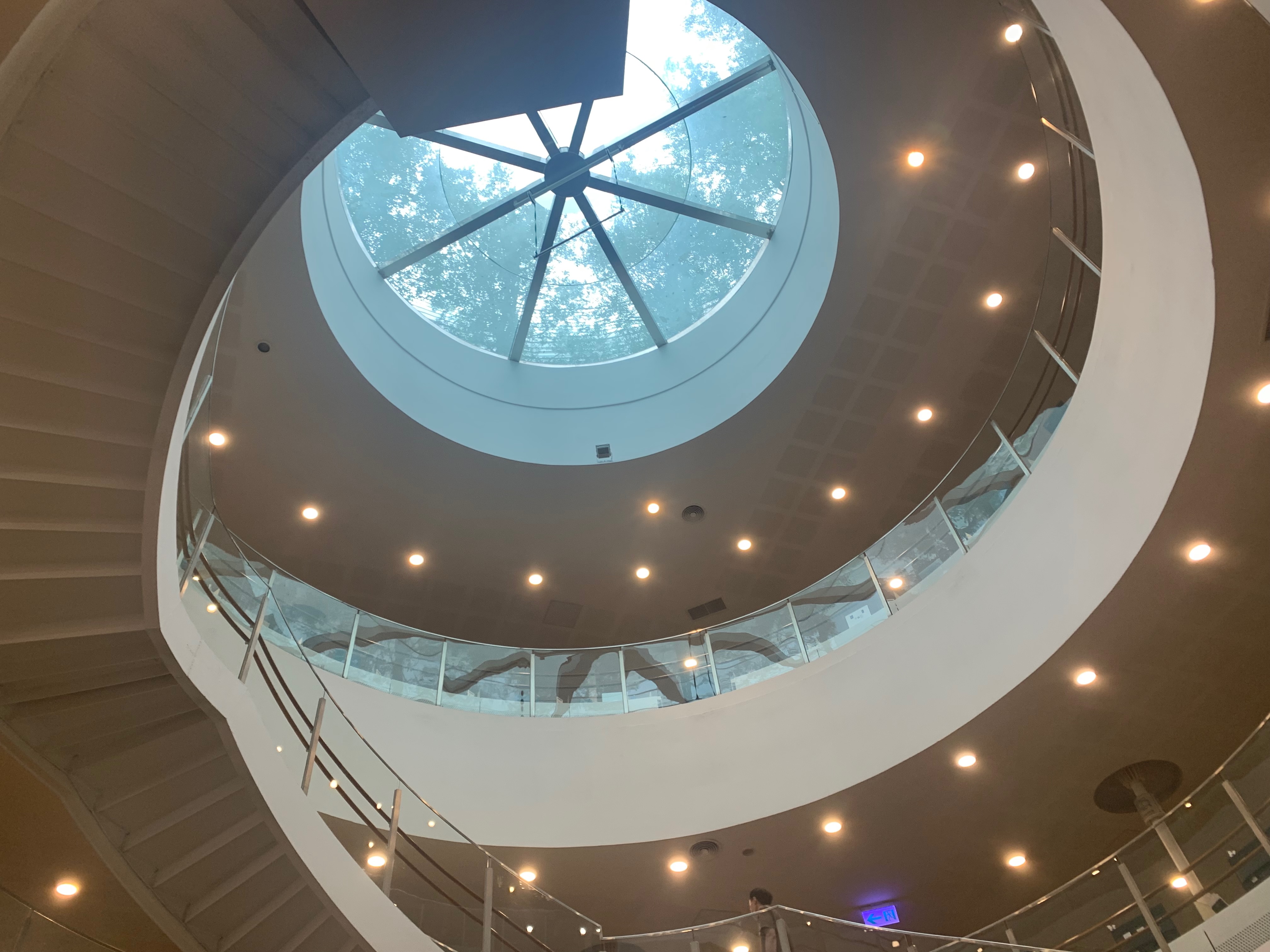
Looking briefly at a few more examples of libraries in Taiwan will impart the scope of ecological and aesthetic iterations based on the Beitou paradigm. The Kaohsiung Public Library (Gaoxiong shili tushuguan 高雄市立图书馆), designed by Ricky Liu and Associates (Liu Peilin jianzhu ceshi shiwusuo 刘培林建筑策师事务所) and the firm of Toyo Ito (Japanese: Itō Toyō kenchiku sekkei jimusho 伊東豊雄建築設計事務所) turns the environmental connection inside-out and upside-down by inserting a floating forest into the library. The library opened in 2014 and is a multi-storied box elevated above a plaza and penetrated from above by a circular atrium. On the outer facades, balconies with lush trees line each story, forming a screen between the interior and the adjacent cityscape and waterfront beyond (fig. 7). Inside, however, the most spectacular feature is the atrium levitating above a spiral staircase. Climbing up the floors (which progress through collections of popular and senior reading on the first floor to science, religion, and philosophy on the seventh floor), one eventually draws level with and finally surpasses the canopy of the trees in the atrium, imparting a feeling of transcendence (fig. 8). This stunning library is part of a network of sixty libraries in the Greater Kaoshiung area, supplemented by a book link service, a mobile library, and a “smart library” in the public transit system, all of which demonstrate the primacy of libraries as a way to engage the public20.
Local libraries on Taiwan’s less-developed east coast feature equally innovative designs. The Taitung County Government Cultural Affairs Bureau Library (Taidongxian zhengfu wenhuachu tushuguan 台东县政府文化处图书管) has stalwart diagonal lines that bend at assertive angles to mirror the rugged peaks that jut skyward behind this coastal city. Interlocking geometric shapes and blocks of colors formed by different materials echo the Austronesian aesthetics that are prominent in Taitung (fig. 9). Built in 1984, the library has undergone upgrades and a targeted interior renovation in 201321. Today, twelve years later, it is undergoing a full interior remodel, which includes converting an area with a public swimming pool into a large open for the library and attesting to the county’s investment in public architecture22.
Taitung is also home to what is the boldest iteration of the model set by the Beitou library, which is why I include it here even though it is a university facility. This is the National Taitung University Library and Information Center (Guoli Taidong daxue tushu zixunguan 国立台台东大学图书资讯管) by Chien Lian-Chuan 陈良泉 of Environmental Dimentional Studios International (Taidong jingxiang lianhe jianzhu shiwusuo 台东景象联合建筑师事务所). Built in 2014, the structure is pyramidal, but with a wedge cut out so that two planes stand upright and perpendicular to one another. One facade is made entirely of soil and grass with a zig-zag staircase embedded into the slope (fig. 10). A stone facade to the east are dotted with irregularly-placed windows that look out over a lake and, beyond, the coast and Pacific Ocean. A similar facade on the west side offers views of the peaks. The unusual design is energy-efficient and built to withstand typhoons that regularly pummel Taitung23. Outside, one can ascend the stairs to summit the library-mountain. From the peak, sweeping views of the sea to the east and mountains on the west unfurl. As a mountain, the library projects skyward even as it is buried under an earthen carapace. This dichotomy of elevation and submersion riffs on indigenous Taiwanese architecture, which was commonly raised above ground level or dug to be partially below ground. It positions the library within the local history and vertiginous topography of eastern Taiwan, where indigenous cultures more successfully resisted assimilation into Chinese culture24.
These examples impart the scope and variety of the diffusion of the Beitou paradigm and show how architectural siting, form, design, and material can charge public architecture with meaning. Tangible and perceptible, structures can not only represent, but can invigorate social and civic values. They can also serve as a foil to and filter for the abstractions of language in print and, even more importantly, the messages transmitted by erratic pixels that fleet and flicker across screens.
The building of the Beitou library introduced a form of architecture that acts as a medium to entwine individual citizens with nature, history, culture, and the social body. Government officials and architects alike recognize the reciprocal relationships between these entities. Taiwan’s Minister of Education Cheng Ying-yao 郑英耀 stresses local characteristics in library design because these resonate with the diverse demographics that the government hopes to engage25. And, at a forum on regionalism in 2017, architect Han Pao-De 汉宝德 found the concept of place to be commiserate with culture, saying, “Good regional architecture is related to history and collective memory”26. (Yi ge hao di diyu jianzhu gen lishi yu jiti jiyi you guan 一个好的地域建筑跟历史与集体记忆有关). Speaking at the same forum, architect Luo Shiwei 罗时玮 shared that architecture can change society. “The existence of architecture,” he says, “is no longer merely for its own meaning, but rather to bring out the energy and imagination of the entire social transformation”27. (Jianzhu di cunzai bu zai zhi shi weile jianzhu ziji benshen di yiyi, er shi dai chu zheng ge shehui zhuanxing di nengliang yu xiangxiang 建筑的存在不再只是为了建筑自己本身的意义,而是带出整个社会转型的能量与想像).
What instigates this transformation? Architecture has the ability to instill “common sense” in individuals, which can then be shared and perpetuated in the public realm.
Writing about common sense, Hannah Arendt stated that it
occupies such a high rank in the hierarchy of political qualities because it is the one sense that fits into reality as a whole our five strictly individual sense and the strictly particular data they perceive. It is by virtue of common sense that the other sense perceptions are known to disclose reality and not merely felt as irritations on our nerves or resistance sensations on our bodies. A noticeable decrease in common sense in any given community and a noticeable increase in superstition and gullibility are therefore almost infallible signs of alienation from the world28.
In the private realm, the library affirms the dignity of individuals by entrusting people to write narratives and draw conclusions. In its public aspect, architecture can generate civic confidence and give form to shared liberal values.
Alexandre Lefebvre identifies local engagement as a crucial to liberalism because it mitigates the stifling uniformity of modernity29. Leaning on the ideas of John Rawls, Lefebvre says a society’s understanding of liberal values does not reside in formal learning but are intrinsic to institutions, history, and “colloquial expressions of liberal democracy”30. The key point made by Rawls is that democracy hinges on citizens with diverse viewpoints recognizing certain principles and having confidence that their fellow citizens likewise recognize them31.
Where can one find these “colloquial expressions of liberal democracy”? Well, one place is in architecture. The Beitou library model is compelling because its values-like connection to place and history, respect for the environment, joy in the pursuit of knowledge, and stimulation of curiosity are shared but do not trespass on other beliefs people hold.
The power of architecture in democratic processes was by Winston Churchill, who, in his appeal to restore the House of Commons, said that it facilitated impromptu exchanges and disagreements that energize the beating heart of democracy. He prefaced his argument with the quotable maxim: “We shape our buildings and afterwards our buildings shape us”32. Moreover, in a library, architecture can merge with the institutional mission to become a nexus of what Jürgen Habermas calls “communicative action,” wherein people transmit traditions and wisdom and engage in negotiation and cooperation33.
The significance of the Beitou paradigm is in part made possible by a unique feature of Taiwan’s democracy, which is the formal role of neighborhood wardens in governance. Seats are won through elections, and prospective or incumbent wardens are under pressure to deliver for their constituents (whom they often know personally) by cooperating with other elected officials or party operatives or by pushing back on them34. Local residents wield considerable influence over construction projects via this micro-representation, which results in a symbiotic relationship between community values and public architecture35.
Today, the proliferation and circulation of misinformation and conspiracy theories imperil democracies. In Taiwan, the menace is even more acute as China prepares to reclaim the island. In addition to withstanding military exercises off its shores and over its skies, the island is besieged by cognitive warfare campaigns. These entail sowing misinformation, spreading propaganda, amplifying divisive content, promoting favored narratives, or downplaying sensitive topics. The objective is to lacerate Taiwan’s social fabric and fray the resolve of politicians and citizenry alike36. Counter measures, such as fact-checking and media literacy, struggle to keep pace with the onslaught of malicious content, which is increasingly fueled by artificial intelligence37. This presents a fundamental dilemma: how can a liberal society effectively counter campaigns without compromising core values?38
Cognitive warfare is pernicious because it leverages neuroscience to undermine mental states and manipulate behavior. It is especially effective when it capitalizes on latent anxieties that increase a target’s susceptibility39. But herein lies an opportunity. People are more likely to ignore malevolent messaging if it contradicts what they already believe or know40. Triangulating from neuroarthistory and new research in neuroscience suggest that architecture can play a role in minimizing the impact of cognitive warfare.
Semir Zeki, a pioneer in the field of neuroarthistory, claims that art acts as an extension of the brain. In interpreting stimuli, the brain draws on essentialised knowledge, which is refined through sensory encounters with stimuli41. Zeki extends these ideas to architecture42. Moving through buildings creates essentialised experiences, eventually informing affect. But, can this change the way a person reacts to new stimuli; say something they read in a blog post or watch on TikTok? Recent studies in neuroscience suggest that it can.
When confronted with stimuli, the brain employs a Bayesian approach. That is to say, it invents a neural representation of what it thinks the initial cause might be, then tests this hypothesis against the ongoing stream of stimuli. The representation is informed by prior experiences and determines how much attention one devotes to the situation, how one interprets it, and, ultimately, how one responds43. This is not to say that architecture and connections to the environment or strong social ties will fully inoculate an individual or population against misinformation and its ilk. It does mean, however, that because perception and action mutually sculpt one another44, positive affect (such as trust) gained through embodied experiences in built environments can blunt one’s susceptibility. Library buildings have even more potential in this regard because many people spend time in them as part of their routines. In repeated visits, the library molds values across diverse swathes of the population, providing boosters to the communal immune system. The beauty and interest inherent in the architecture motivates people to recognize and affirm the social bonds that cognitive warfare seeks to dissolve.
The Beitou library established a new paradigm, and other library projects across Taiwan show how it can be adapted to various localities to connect people to environments, histories, and one another. Creative inspiration by architects, coordination by the Ministry of Education and other government entities, along with community autonomy and citizen engagement, suggest that the Beitou model provides a way to serve the needs of individuals while activating civic values. Enjoining people through embodied and sensory experiences in environmental and historical contexts, these libraries manifest the ideas of Critical Regionalism as articulated by Kenneth Frampton. Through materials and aesthetics, they stimulate tactile experiences that build to common sense among people from various demographics, with unique interests, and at different stages of life. Architecture can initiate a dynamic between designer and users to promote civic interactions and understanding. This is evident in Taiwan’s local libraries where individual and community agendas converge and converse in communicative action.
Ultimately, these inscribe common values in the public consciousness. Libraries in the Beitou model stand as concrete mediators, not just of reliable information, but of a shared reality. Neuroarthistory suggests that architecture can determine affect, and neuroscience indicates that this influences how information is appraised and acted upon, even in the face of atomized and clashing perceptions of reality that people navigate on screens. This underscores the capacity not just of libraries, but more generally of public architecture in democratic societies to revitalize liberal values and fortify civic resilience.
I would like to thank the Taiwan Ministry of Foreign Affairs for supporting this research.
The text follows conventions of Pinyin Romanization except when alternative Romanizations are commonly used for the names of people and places.
notes
Mandhana, Niharika et al. 2025. “See How a Chinese Invasion of Taiwan Could Unfold.” Wall Street Journal, December 7. https://www.wsj.com/world/china/how-china-chinese-invasion-taiwan-ba7e3916. Chen, Jeremy. 2025. “The Challenges Taiwan Faces in Cognitive Warfare and Its Impact on US-Taiwan Relations.” Journal of Indo-Pacific Affairs 8, no. 1: 89-101, 89.
Lee Chien-lang 李乾朗. 2003. Taiwan gu jianzhu: tu jieshi dian 台湾古建筑: 图解事典 [Taiwan's Historic Architecture: An Illustrated Dictionary]. Taipei: Yuanliu chubanshe, 221.
Xu Yihong 徐逸鴻. 2021. Rizhi Taibei cheng 日治臺北城 [Meiji Taipei city]. Taipei: Maotuoying chuban, 56-59.
Ivi, 12.
Huang, Chih Huei. 2015. “Ethnic Diversity, Two-Layered Colonization, and Complex Modern Taiwanese Attitudes toward Japan.” In Japanese Taiwan: Colonial Rule and its Contested Legacy, edited by Andrew D. Morris, 133-154. London: Bloomsbury Academic. For the conflation of “the past” and “history” in Chinese and implications for architecture, see Lin, Francis Chia-Hui 林家晖. 2017. Architectural Theorisations and Phenomena in Asia: The Polychronotypic Jetztzeit. London: Palgrave Macmillan, 48-50.
Tseng, Shu-Hsien. 2007. “An Eco-Building, A Health Life, and Good Service: A New Century in Public Library Architecture.” Public Libraries 46, no. 4 (July/August): 50-55, 53.
Lin Sheng Fong et al, eds. 2016. Diyu x jianzhu: Shi ge tansuo 地域 x 建筑: 十 个探索 [Regionalism: 10 Taiwanese Architects’ Inquiries]. Taipei: Caituan faren kongjian muyu wenhua yishu jijin hui, 14.
Frampton, Kenneth. 1983. "Towards a Critical Regionalism: Six Points for An Architecture of Resistance." In The Anti-Aesthetic: Essays on Postmodern Culture, edited by Hal Foster, 16-30. Port Townsend, WA: Bay Press, 20.
Ivi, 28.
“Exploring Old Tainan: Tainan Historical Maps.” Taiwan Digital Archives. Accessed October 21, 2025, http://digitalarchives.tw/Apps/TainanHistoricalMaps/files/4497/index_en.html.
Fu, Chao-Ching. 2007. "Taiwaneseness in Japanese Period Architecture in Taiwan." In Refracted Modernity: Visual Culture and Identity in Colonial Taiwan, edited by Yuko Kikuchi, 169-191. Honolulu: University of Hawai’i Press, 176-179.
Xie Zongzhe 谢宗哲. 2023. Sanbu Zhong di Taiwan jianzhu zai faxian 散步中的台湾建筑在发现 [A rediscovery of Taiwan architecture while walking]. Taipei: Chuangyi shiji, 179.
Huang Yinyu 黄恩宇. 2022. “Tainan chengshi kongjian lishi tuceng di fenli yu diehe.” 台南城市空间历史图层的分离与叠合 [Tainan history: rupture and continuity]. In Jianzhu zhi jian di juli: 2022 Tainan jianzhu san nian zhan 建築之間的距離: 2022 台南建築三年展 [Architecture: di-stances in-between: 2022 Tainan triennial], edited by She tun faren Tainan shi jianzhushi gonghui, 18-21. Tainan: Tianyuan chengshi wenhua shiye you xian gongsi.
Chen Yulin. 2023. Interview by author. November 2.
Lin Guangmei 林光美, ed. 2013. Tushuguan jianzhu 图书馆建筑 [Library architecture] Vol. 6, Zhonghua renmin tushuguan shiye bainian huigu yu zhanwang中华民国图书馆事业百年回顾与展望 [A century of retrospect and prospects of the library industry in the Republic of China]. Taipei: Wunan tushuguan chubanshe, 6.
Denton, Kirk A. 2021. The Landscape of Historical Memory: The Politics of Museums and Memorial Culture in Post-Martial Law Taiwan. Hong Kong: Hong Kong University Press, 1-25. https://doi.org/10.2307/j.ctv1wd02k5.
JUT Museum (Zhongtai meishuguan 忠泰美術館) 2024-25. “Shifting Horizons: The Generation of Emancipatory Architecture in Taiwan” (qun dao fuxian: Taiwan jianzhu di jieyan shidai 群岛浮现;台湾建筑的解严世代] . Exhibition in Taipei from August 31 to January 12.
Jiaoyu bu 教育部 [Ministry of Education], ed. 2025. 113 Nian chuangyi yuedu kaimai: gonggong tushuguan yuedu tuiguang liang wenan 113 年创意阅读开麦: 公共图书馆阅读推广良文案 [113 years of opening creative reading: good writing for promoting reading in public libraries ]. Taipei: Guojia tushuguan qiehua tuiguangzu bianji, 4.
Yen, Y.C. James. 1954. “Foreword.” In Ding Xian: A North China Rural Community, vii-ix. New York: Institution of Pacific Relations, ix.
Pan, Cheng-yi. 2018. KPL: A Flipped Library, Flipping the City as Well. Kaohsiung Public Library. https://tkpark.or.th/stocks/extra/004ac9.pdf.
Taitungxian 台东县. “Taitung zhengfu wenhuachu tushuguan” 台东县政府文化处图书馆 [Taitung County Government Cultural Affairs Bureau Library.] Accessed October 10, 2025. https://culture.taitung.gov.tw/facility.
Chen, Irene. 2025. “Taitung xianli tushuguan 5 da liangdian” 台东县立图书总馆5大亮点. Tatler Asia (July 5) https://www.tatlerasia.com/homes/architecture-design/taitung-public-main-library-zh-hant.
Yang Tien-hao 楊天豪. 2021. Taiwan lü jianzhu 台灣綠建築 [Taiwan green architecture]. Taipei: Chen xing chuban, 88, 93.
Fu, Chao-Ching. 2007. Op. cit., 171.
Jiaoyu bu 教育部 [Ministry of Education], ed. 2025. Op. cit., 4.
Lin Sheng Fong et al, eds., 2017. Diyu x jianzhu: San ge luntan 地域 x 建筑: 3 个论坛 [Regionalism: Three forums]. Taipei: Caituan faren kongjian muyu wenhua yishu jijin hui, 12 and 17.
Ivi, 51.
Arendt, Hannah. 1998. The Human Condition. Second edition. ed. Chicago: University of Chicago Press, 208-209.
Lefebvre, Alexandre. 2024. Liberalism as a Way of Life. Princeton: Princeton University Press, 40.
Ivi, 26.
Rawls, John. 1996. Political Liberalism. New York: Columbia University Press, 9-11, 15-22.
Churchill, Winston. 1974. “A Sense of Crowd and Urgency, October 28, House of Commons.” In Winston S. Churchill: His Complete Speeches, 1897-1963, edited by Robert Rhodes James, 6869-6873. New York: Chelsea House Publishers, 6869.
Habermas, Jürgen. 1994. The Past as Future: Vergangenheit als Zukunft. Edited by Michael Haller and Max Pensky. Lincoln: University of Nebraska Press, 111.
Read, Benjamin L. 2020. “Neighborhood Politics in Taipei: Democracy at the Most Local Level.” In Taiwan in Dynamic Transition: Nation-Building and Democratization, edited by Ryan Dunch and Ashley Esarey, 95-120. Seattle: University of Washington Press, 95-96, 105-109.
Denton, Kirk A. 2021. Op. cit., 199-213.
Iida Masafumi. 2025. “China’s Chilling Cognitive Warfare Plans.” The Diplomat. May 5, 2025.
Reuters. 2025. “Taiwan Says China Using Generative AI to Ramp Up Disinformation and 'Divide' the Island.” Reuters, April 7. https://www.reuters.com/world/asia-pacific/taiwan-says-china-using-generative-ai-ramp-up-disinformation-divide-island-2025-04-08/.
Chen, Jeremy. 2025. Op. cit., 99-101.
Hung, Tzu-Chieh, and Tzu-Wei Hung. “How China's Cognitive Warfare Works: A Frontline Perspective of Taiwan's Anti-Disinformation Wars.” Journal of Global Security Studies 7, no. 4 (2022): 1-18, 2-3.
Ivi, 2, 8.
Zeki, Semir. 1999. Inner Vision: An Exploration of Art and the Brain. Oxford: Oxford University Press, 8.
Zeki, Semir. 2019. “Beauty in Architecture: Not a Luxury, Only a Necessity.” Architectural Design 89, no. 5 (September): 14-19.
Barrett, Lisa Feldman, and W. Kyle Simmons. 2015. “Interoceptive Predictions in the Brain.” Nature Reviews Neuroscience 16, no. 7: 419-429, 421-427. Siegel, Erika H., et al. “Seeing What You Feel: Affect Drives Visual Perception of Structurally Neutral Faces." Psychological Science 29, no. 4 (2018): 496-503.
Press, Claire, et al. 2024 “The Synergistic Relationship Between Perception and Action.” In Expected Experiences: The Predictive Mind in an Uncertain World, edited by Tony Cheng, et al. Routledge Studies in Contemporary Philosophy, 76-95. New York: Routledge, Taylor & Francis Group, 85-87.
Edited by: Annalucia D'Erchia (Politecnico di Milano) and Claudia Tinazzi (Politecnico di Milano)
Santiago Araque
Ekaterina Golovatyuk
Alessio Battistella